
Treasury of Meanings
Part 1. The Queue for the Bow
Introduction
The Queue for the Bow. This story began over tea, with an ordinary joke about Thought. She arrives all dressed up, with a little bow: words smoothed, meaning powdered.
But Naobum did not look into the little mirror. He saw the whole frame at once and noticed: the bow is not a decoration.
Perhaps it is the very thing holding the whole outfit together.
So the kitchen giggle slowly changed. It became a tale about Tsar Gorokh, wisdom, and the queue for the bow.
The Tale of the Royal Outfit
In a certain kingdom, in a certain realm, there once lived Tsar Gorokh.
He was no ordinary tsar. He was very wise.
At least, that is what people said at court, in the square, and in chronicles.
Maybe it happened in those places. There, the right words brought a good post or a warm caftan. At least, they brought a place closer to the samovar.
Tsar Gorokh truly loved wisdom.
He gathered it from everywhere: from all lands and old lineages. Also from songs, tales, women’s wit, and the observations of those who could see.
Of course, much wisdom gathered around the tsar. It no longer fit into the guarded chests.
Then the court tailors decided to sew a royal outfit from it.
The fabric came out unbelievably wondrous: thin, almost transparent, shining in the sun. It shone so strongly that people squinted and said:
— What a tsar! Such a sage! What an outfit! Such brilliance!
The tsar himself, one may suppose, was also delighted by his own shine.
He would step onto the balcony and smooth the folds of wisdom on his clothes. Then he stood more grandly — and everyone around rejoiced.
The Oddity in the Outfit
But that outfit had one oddity. A little bow shone in its very center.
Not on the side, not above, not below, not somewhere near the edge.
Right in the very center.
Court sages explained that it was a special sign of royal intelligence.
Chroniclers wrote that the bow meant the highest degree of understanding.
Singers sang that without this bow, the world would have fallen apart. Long ago, it would have become tiny buttons.
One woman looked at the tsar and narrowed her eyes. Then she said quietly:
— Magnificent, of course, but it does not inspire trust.
No one heard her. Or they pretended not to hear.
At court, this happens often: the thinner the truth, the louder the music nearby.
And according to the tale, the tsar then decided to choose another new wise companion.
Messengers were sent out, virtues were listed, notices were posted, and a queue was formed.
They said it was a great happiness. The tsar himself, the outfit itself, the bow itself.
One way or another, a queue formed. Women came closer and looked. At the same time, some bowed, some stayed silent, and some thought their own thoughts.
Then one woman, passing by, stopped. She looked at the shine, naturally at the bow. Then she looked at the tsar and said:
— As if I ever stood in line for your bow.
And she went off to drink tea.
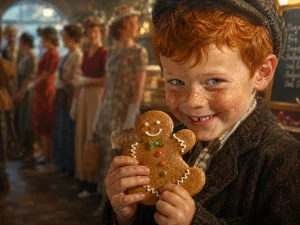
The Boy with Gingerbread
At first everyone gasped. Then they made noise. After that, they began explaining that she, of course, had understood nothing.
But a small boy stood nearby and ate gingerbread. Suddenly he shouted:
— But the bow is not real!
And at that moment the square became incredibly quiet.
People believed that everything about the tsar was real, because it shone like the sun.
And the bow? — There was no way without it. The whole outfit rested on it.
It was sewn with golden threads, from so many voices, destinies, and silences.
And just imagine how it happened.
Because of some small boy, the bow came into question. Now the whole throne did too.
That woman had refused to stand in line for the bow. She probably never even learned about it.
She returned to her little paradise. By the way, she had created it herself. Her own hands shaped three hundred square meters of land.
She drank tea from her favorite porcelain cup on the terrace. Meanwhile, she breathed in the scent of flowers and rejoiced in the real Sun.
In addition, she savored every moment. Apparently, she knew a simple secret: life is measured not only by length and width. It is also measured by depth.
On the surface — the tsar, the outfit, the queue, and the bow.
In the depth — a question: what is the image everyone admires sewn from?
Sometimes a person stands in the center of radiance. It seems all the light belongs to him.
Yet look closely at the fabric of that radiance. There, we may find other people’s voices, other people’s destinies, and other people’s silence.
Then the bow becomes the sign of a knot.
It shows the place where many threads are tied into one beautiful image.
Here, measure already matters. One thing is to say honestly: the outfit is woven from planetary wisdom.
Something else entirely is to step onto the balcony. Especially as if the whole fabric was born from one separate person’s qualities and abilities.
In this sense, the tale does not argue with wisdom. It only asks: whose light do we see when we admire the shine?
A Small Bridge to the Game
When The Journey of Meanings appears on Udanna, this parable may gain one more entrance.
For example, the reader may see a question:
What did you notice in the bow?
A decoration on the royal outfit.
The knot of borrowed wisdom.
A little door into another side of the tale.
All answers will be right.
Each one will simply lead along its own path. One goes toward form, another toward the Scales of Resonance. The third returns to the kitchen. There, Naobum already drinks tea and smiles into his mug.
Because in a good sense, the bow is not the end of the story.
This Is the Place Where the Tale Was Tied
Sometimes one child’s phrase is enough.
Like a small lantern in a cave.
It lets a thousand-year-old legend
suddenly reveal what rests on what.
— But the bow is not real!
Udanna Light and Awareness, texts arrive on their own.