Expansion Map
Part 1. Expansion Map. The Fabric of the World
The Fabric of the World
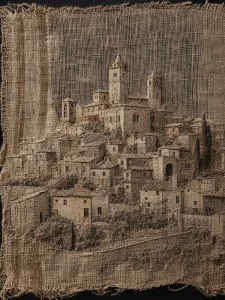
First of all, the world can be seen not as a set of separate objects, but as a living fabric of the world.
In such a picture, space no longer looks like an empty stage where things simply stand beside one another.
On the contrary, it becomes a field of intersections, density, response and movement.
This fabric of the world is continuous, but it is not uniform.
In some places the fabric of the world becomes denser, in others it spreads more softly, and elsewhere it gathers into noticeable knots.
Moreover, each such knot does not merely occupy a place.
It holds a stable manifestation of life as the fabric of the world, experience or interaction.
In the Expansion Map, this view is especially important.
Here, expansion does not mean only movement into the distance or the appearance of new territories.
In essence, expansion begins when a person sees more connections than they saw before.
Then the world stops being a flat road and turns into a living network of directions.
In other words, expansion happens not only through distance.
It appears through understanding where one layer touches another, where the past enters the present, where a person is connected with place, environment, time and other forms of life.
Kons as Knots of Manifestation
In this living fabric, there are knots. They can be called kons.
Kons are not only people and not only individual beings.
They are any points of stable manifestation where life, meaning or interaction gathers into form.
Thus, a person is a kon, but not the only one. A house can also be a knot of connection.
A place, a road, a forest, a city, a family, memory, a craft, a custom or an inner experience — all of this, in a certain sense, can become a kon.
In addition, even inside a person there is no single simple center.
Microflora, bacteria, cellular systems, breathing, digestion, body memory and inner responses also participate in the common network.
A person, therefore, is not one knot, but a system of knots within knots.
That is exactly why the Expansion Map cannot be only external geography.
It shows not simply a path across the earth, but multi-level embeddedness.
A person moves through the world, yet at the same time the world moves through them: through the body, perception, memory, habits, fears, care and the ability to respond.
ZaKons of Alignment
Lines of connection pass between kons. However, these are not simply random threads between objects.
They can be seen as ZaKons of alignment, because they not only connect, but also regulate interaction.
If the knots are not aligned, then the connection begins to tear.
Still, if the connection is too weak, the system falls apart.
Therefore, the living world is held not by one force, but by constant tuning between separate participants of the network.
For example, a person must align with the body, the environment, society, time and their own inner state.
A place also requires alignment: one city accepts at once, another requires getting used to, a third opens only through experience and attentive presence.
In this way, the Expansion Map becomes a map of ZaKons.
It helps to see not only where to go, but also what must be aligned with.
After all, movement without alignment turns into collision, while attentive expansion becomes a way to enter the network more gently and more precisely.
Part 2. Time as a Living Picture of Manifestation
The Past as a Layer
Time in this picture does not resemble a straight line where the past has remained behind, the present has flashed by, and the future waits ahead.
Rather, time resembles a living picture that changes every moment, while the previous version does not disappear completely.
The past does not go into emptiness. It becomes a layer.
It can become memory, a habit, soil, a trace, a warning or quiet material for the future.
In particular, the distant past seems to throw a small brick into what will one day manifest farther ahead.
Therefore, the past did not only “happen.”
It participates in assembling the next state.
Even if a person no longer remembers the source of some movement, that source may continue to work inside them through language, body, family experience, culture or place.
In the Expansion Map, this is especially important.
When a person moves forward, they do not carry an empty backpack with them, but many layers.
At times the path opens not because the person invented everything in advance, but because previous experience has finally found the place where it could manifest.
The Present as an Assembly Point
The present in such a model is not simply a short instant between the past and the future.
More precisely, it is an active assembly point where different elements come together and begin to align.
Here memory, body, place, circumstances, desire, limitation, possibility and time meet.
It is not ready in advance and does not lie somewhere ahead like a closed thing.
If all of this is not assembled, then the future has not yet manifested.
It appears when the necessary elements coincide.
That is exactly why the future can be seen not as a frozen plan, but as a form that gradually becomes visible.
At first it is almost indistinguishable.
Then an outline appears.
Eventually, with sufficient alignment, it becomes a step, an event, a direction or a new space of life.
In this way, the present becomes not a point on the calendar, but a place where ZaKons are at work.
In it, the past gives material, the future receives form, and a person participates as a kon inside the common network.
They do not observe time from the outside.
They themselves are part of the knot through which the picture continues to manifest.
The Future as Manifestation
The future, in essence, does not exist in advance in a finished form.
It is not stored somewhere fully assembled, only to fall into life later.
Most likely, it manifests gradually when the network of connections reaches the necessary state.
Thus, a seed does not contain a finished garden as an object.
However, it contains the possibility of a garden if soil, water, light, time and care appear.
In exactly the same way, the future is not an empty dream, but it is also not a rigid fate.
It depends on which connections are able to align.
The Expansion Map helps to see this process as movement through layers.
A person moves not only through space, but also through probabilities.
They choose a place, but at the same time they choose connections.
They change the environment, but the environment also changes them. As a result, the new future appears not separately from the path, but directly inside it.
Part 3. Living Expansion and Adaptation of Form
Adaptation Is One of the Main Qualities of Life
It is needed by a person, the body, a family, society, a place and any system that wants to continue existing.
After all, the environment changes, connections change, conditions change, and therefore a living form cannot remain absolutely rigid.
If a form cannot adjust, it breaks.
If it changes without measure, it loses recognizability.
Therefore, the living is held between two dangers: to freeze or to dissolve.
For example, the joke that dinosaurs died out because they showed off too much while bedbugs live on sounds funny.
However, it contains an exact turn of meaning. A large form does not always win.
A small, inconspicuous and flexible one may turn out to be much more stable if it knows how to embed itself in the network of conditions.
This does not mean that one is better than the other.
It speaks of different strategies of embeddedness.
One living thing holds scale, another takes strength from subtle penetration, a third wins through speed, and a fourth through the ability to wait things out.
Perception as the Key of Alignment
Meaning also does not exist for a person without a form of perception.
It may be stable in its depth, but the form through which it becomes accessible constantly adjusts to the one who sees.
Therefore, one and the same essence can manifest through different images.
However, this does not mean that truth changes every time. More precisely, the form of access to it changes.
Meaning remains deeper, while the image selects the language that can be heard.
Thus, the Expansion Map shows another important layer.
Expansion happens not only when a person learns new places.
It also happens when they begin to see a previous meaning in a new form.
As soon as perception changes its angle, the map becomes wider.
Form, Network and Continuation
If all of this is gathered together, then the world can be seen as a living fabric where kons are knots, ZaKons are connections of alignment, adaptation is a way of continuation, and the present is an assembly point.
In such a system, life exists where form is able to adjust to the network of connections without losing its inner meaning.
If connections tear, movement stops. When a form does not hear the environment, expansion turns into collision.
If the environment does not accept the form, a rupture appears.
Still, when tuning appears between them, the path opens.
A person begins to see not only separate events, but also patterns between them.
A place stops being a random point. Time stops being a simple line.
And the future begins to manifest as a result of alignment.
So, the Expansion Map is a map of a living network.
It shows that the path runs not only across the earth, but also through connections, layers of time, adaptation of form and the ability of perception to recognize meaning in different manifestations.
Eventually, expansion begins where a person stops seeing the world as a set of alien objects.
Instead, they notice the fabric, the knots, the lines of alignment and their own place inside the living picture.
Then the path becomes not an escape into the distance, but an increasingly precise participation in the world.
Our Telegram channel: Udanna.