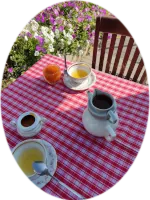
Tea Conversation
Part 1. The Hunter’s Law. When Choice Becomes a Trap
Leaving the Role of Victim
The Hunter’s Law: how to leave the role of victim
Sometimes a person thinks they are being given a choice.
In reality, they are only being offered different doors into the same circle.
In childhood, perhaps, this is felt especially sharply.
As usual, Grandmother might say over breakfast:
— All right, Anya, choose. Either you clean the house, or you go to the garden.
By definition, there seems to be a choice.
House or garden.
Broom or garden beds.
Room or soil.
But inside, it was immediately clear: this was a trap. Whichever option I chose, the day would no longer be mine.
So in such a case I would ask:
— May I think about it?
After a little thought, Grandmother would agree:
— Well, think. When you decide, tell me.
And I sat there wondering why I had to “decide” at all. I did not want to; those were Grandmother’s games, not mine.
Grandfather had a whole workshop full of toys, and he played with them himself without bothering me.
Grandmother could not stand it any longer:
— Well, what have you decided?
In turn, I answered:
— May I think a little longer? Only not here, but perhaps beyond the gate?
And that was where the real Expansion Map began.
While a person sits inside someone else’s circle, they choose only the form of obedience.
Beyond the gate, however, the air is different.
Then Grandmother might say:
— All right, but do not take a single step away from the gate.
Of course, I had no intention of running away.
For me, the main thing was to leave the circle.
Outside Grandmother’s territory, space itself might take my side.
It had happened before: a neighbor might come to see Grandmother.
Or, luckily, Grandfather might run out of cigarettes.
Moreover, Grandmother might suddenly need to go to the shop.
In addition, the television could catch her attention.
One way or another, a little more time would pass, and they would simply forget about me.
In general, even as a child I understood something important.
Do not agree immediately, and then see how things unfold.
Victim and Hunter
There is a state of being a victim.
It is when circumstances have already assigned a person a role.
Flies keep bothering you.
Beetles crawl onto the potatoes.
The line stands still and does not move.
In all these cases, a person may not notice how they stop being the master.
They are no longer choosing.
They only react.
As a rule, the victim endures.
The hunter studies behavior.
In Russian, the word “hunter” is linked to “I want” and “I feel like it.”
Besides, a hunter chooses their own direction.
Moreover, they do not merely fight off what is bothering them.
They also reverse the roles within the situation itself.
Then the circumstance stops giving orders.
Instead, it becomes material for action.
Grandmother, Flies, and the First Hunt
In fact, Grandmother herself once showed me this law.
As usual, they kept livestock, and each time it was something different. That meant there were many flies, and they pestered everyone.
One day Grandmother made me an offer:
— I will pay you one kopeck for every fly you catch.
She did not specify where to catch them, how to catch them, or how many.
At first I caught flies inside the house.
Then I moved into the yard.
After that I began setting bait and traps.
Even the outdoor toilet came into use.
All in all, I nearly bankrupted Grandmother.
But the main thing was not the kopecks.
The flies stopped being the ones who bothered me. They became the object of my hunt.
I studied their routes and, moreover, their behavior.
I counted the catch.
I invented methods.
Most importantly, excitement appeared: the more flies there were, the better it was for me.
Funny as it sounds, flies have not bothered me since then.
Of course, one could say that screens are everywhere now.
But inwardly I know something else: once, I stopped being their victim.
Part 2. Colorado Beetles and Bottles
Beetles
Colorado potato beetles were even more interesting.
Once, they simply tormented people.
As soon as they appeared, a person immediately became a victim: go collect them, save the potatoes, endure it.
Imagine the following scene.
Grandmother looks at the bottles filled with beetles and asks:
— Why do you need so many bottles? Is one bottle not enough for the beetles?
I answered:
— I am counting them. Here I have ten beetles in each bottle. In this one, there are one hundred. And in this one, I am going to collect a thousand.
Grandmother and Grandfather laughed for a long time.
But after that, I never collected beetles anywhere again.
Because at that moment I was no longer a victim of the garden.
I became the hunter.
It had been: “I was forced to collect beetles.”
It became: “I am conducting a hunt and counting the catch.”
This is how the center returns.
Sunflower Seeds, Knives, and Someone Else’s Script
The Hunter’s Law works not only with flies and beetles.
Sometimes a script hides in a small thing.
For example, in sunflower seeds.
You crack one, then a second, then a third.
And suddenly you are no longer eating the seeds; the seeds are controlling you.
I felt this as a child and forbade myself to eat them.
Not because sunflower seeds were bad.
It was because I disliked the feeling that something was controlling me.
With a knife, it was different.
On Sakhalin, we went mushroom picking.
I had a homemade knife.
I liked it because it almost never needed sharpening.
But when I held it in my hands, I stopped recognizing myself.
I could cut off a branch for no reason.
Then I would pull my hand back.
Some time later, I would catch myself making the same movement again.
And this despite the fact that as a child I had written:
“Everything is alive in this world, even stones and water.
People, do not break branches; they hurt too, ladies and gentlemen.”
So the matter was not only in me.
More precisely, not entirely in me.
The tool also carried a script.
If an object in a person’s hand changes them faster than they can bring it into alignment, then the object carries a powerful script.
Here the Hunter’s Law comes into play again.
One needs to notice the moment when it is no longer you guiding the object, but the object trying to guide you.
A Line for the Unknown
The same thing happens with circumstances.
One night, at about four in the morning, Kolya and I drove to a gas station.
The roads were empty. There were almost no cars.
A line stood at the station. On our side it was small, while on the other side it was five times longer. Neither line moved.
Kolya stayed behind the wheel. I went to investigate.
About ten meters from the windows, I heard dogs barking. Then I approached a group of people.
Nobody knew anything.
Maybe fuel would be delivered.
Maybe not.
The station would open at seven.
Then Kolya said:
— Let us go home. I have never stood in line for the unknown before.
When our fuel runs out, I will park the car.
If things have not improved by then, I will walk.
And we left immediately.
All in all, the trip was not without result.
We learned that going there at night changed nothing.
Most importantly, we showed ourselves that we were making the decision, not the circumstance.
A line may not be a road to a resource.
Sometimes a line is a form of shared anxiety.
A person becomes a victim not because there is no choice, but because they quietly join someone else’s waiting.
Part 3. The Fuel Truck as a Guiding Star
The Fuel Truck
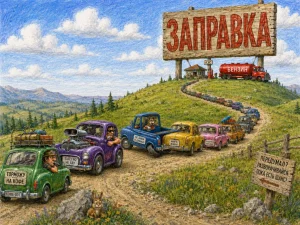
It became even funnier with fuel trucks.
Drivers used to keep away from them.
Dangerous cargo. Better not to come close.
Now a dense procession of cars may trail behind a fuel truck: “What if it is going to a gas station?”
And now the same object changes its meaning.
Yesterday the fuel truck was a risk.
Today it has become hope.
The object is the same.
The tank is the same.
The road is the same.
But the scenery changed, and people began to behave differently.
This is often how a person is directed.
No one necessarily has to tell them: “Do this.”
It is enough to change the conditions.
There is no clarity.
There is no resource.
Everyone is waiting.
Someone has driven somewhere.
Somewhere, “perhaps they will bring some.”
And the person begins moving in the required direction on their own.
They think they are choosing. In reality, they are already reacting to scenery that has been created.
The Hunter’s Law
The Hunter’s Law begins where a person notices the influence.
Not when they have already won.
Earlier.
When they feel: “This is no longer my choice. The script is leading me.”
Sunflower seeds suggest continuing.
A knife suggests cutting.
A line suggests waiting.
A fuel truck suggests following.
A book suggests entering its system.
A teaching offers an agreement.
Flies suggest irritation.
Beetles suggest becoming a victim of the garden.
Each time, one can ask: is this my step, or am I already being carried along?
If a person notices in time, they have a center again.
Sometimes one needs to go beyond the gate or refuse to stand in line for the unknown.
Sometimes one needs to park the car and walk.
At another time, one needs to declare a hunt on what is bothering them. Not out of anger. Out of precision.
Because the victim endures the attack.
The hunter studies behavior.
Realization
The Hunter’s Law does not teach a person to attack the world.
It teaches them not to surrender their center to whatever makes the most noise.
If a circumstance keeps bothering you, it can be studied.
If an object leads your hand, it can be stopped.
If a line pulls you in, you can leave it.
When a choice turns out to be a trap, you do not have to choose inside someone else’s circle.
The Expansion Map begins where a person sees not only the road, but also the script that road is offering.
Then freedom appears.
Not loud, not demonstrative, and not heroic.
A person simply realizes: I am not the victim of this circle.
I can see it. That means I can choose my own move.
Summary
Freedom does not begin where influence is absent. Influence is always present.
Objects, people, habits, fears, lines, words, tools, and circumstances constantly offer a person their scripts.
Yet a person remains the master wherever they manage to feel: this is no longer my movement.
Then they can refine the action.
Not fight blindly.
Not become a victim.
Instead, see the behavior, restore the center, and make their own move.
The victim performs someone else’s duty.
The hunter turns the circumstance into their own move.
This is how a funny story about flies and Colorado potato beetles becomes part of the Expansion Map.
Because expansion does not begin with vast spaces.
Sometimes it begins with a simple thought: when something keeps bothering me, I do not have to endure it.
I can find out who wins.
Conclusion
If a person is satisfied with the role of victim, either they like it or they have a victim syndrome.
As soon as a person begins to understand themselves and the situation, they put everything in its proper place.
They understand that every little house has its own toys: Grandmother has hers, the child has different ones, and Grandfather has a third set.
That is when the person becomes a hunter.
Udanna Light and Awareness, new doors of meaning.