
Tea Conversation
Part 1. The Hexagonal Table of Answers. How the Past Offers Us a Choice
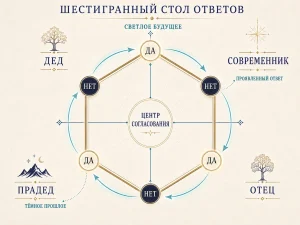
An Image as a Map of the Subconscious
The subconscious is not a warehouse of the past. It is more like an underground workshop where lived experience is purified, connected, and turned into a foundation.
Life passes through a person, and experience seems to flow down into the subconscious.
Without a doubt, its inner layers filter and combine it.
Meanwhile, the right signal opens an exit.
Meaning rises as an image, a slip of the tongue, or a sudden realization.
Consciousness receives it and weaves it into Life.
A large picture may remain before our eyes for a long time, yet become visible only from a distance.
Thus, the Hexagonal Table of Answers also first appeared to be a familiar family image.
Imagine a great-grandfather, grandfather, father, and contemporary seated at the same table.
The elders seem to warn the younger ones about dangers and offer them advice.
At first glance, there is nothing unusual here.
This has happened throughout all times.
The elders spoke, the younger ones listened, and family rules passed from one generation to the next.
Yet the moment we approached the image more closely, the ordinary table turned into a honeycomb.
The Honeycomb
The Table seemed to acquire corners, axes, opposite points, and hidden lines of movement.
It became clear that answers are not passed on directly.
Each of them travels through its own time, through lived circumstances and the inner measure of a person.
At the Hexagonal Table of Answers, the great-grandfather sits diagonally opposite the contemporary.
He occupies the farthest point of the dark past.
Not a bad past, of course, but a dense and heavy one that helped people survive.
His answers were born in a world where a mistake could cost a home, a harvest, freedom, and sometimes Life itself.
Perhaps that is why his voice carries so much caution.
For example: do not trust immediately; protect what has been accumulated; do not take unnecessary risks; think about safety first.
At that time, such an answer could save the whole family.
It became a bright point of experience and settled into the shared memory.
The grandfather received not the original situation itself, but its result.
The father found himself closer to a new era.
He still hears the family rule, yet encounters circumstances the great-grandfather never knew.
That is why the old answer begins to soften, become more precise, or cause doubt.
In the end, the contemporary receives this entire line in a compressed form.
There is no need to relive every episode of family history from the beginning.
A quick answer rises on its own: yes, no, dangerous, possible, and so on.
Yet this signal contains far more than one short word.
Behind it stands a long road traveled by generations.
This is exactly what the Hexagonal Table of Answers reveals: the past does not disappear.
It becomes compressed into advice, habits, bodily reactions, and almost instantaneous decisions.
Part 2. How the Line of a Quick Answer Runs Through the Honeycomb
Alternation
Looking at the corners of a hexagonal cell, one can see an alternation:
yes — no — yes — no — yes — no.
Each point therefore stands in opposition to the one beside it.
One state opens the way, while another checks the boundary.
One attracts, while another stops.
The line of a quick answer resembles an electric current.
It does not remain still or consist of identical confirmations.
The impulse moves through the difference between the points.
An opposite appears ahead, another opposite remains behind, and a living spark of decision runs between them.
In this image, “yes” opens movement, while “no” clears away unsuitable directions.
Yes — one can pass here.
No — there is a risk here.
Yes — this matches the goal.
No — the price is too high.
Yes — this turn is possible.
No — this path destroys the measure.
One decision appears at the exit, yet it is born from a whole sequence of inner reversals.
The Hexagonal Table of Answers shows why a quick signal can arrive almost instantly.
It is not created from nothing at the moment of the question.
The impulse runs along an already familiar conducting line, connecting the brightest points of the past.
Neutral days gradually fade.
Danger, rescue, loss, a successful risk, powerful love, or deep disappointment leave a bright trace.
The quick answer moves precisely along such flashes.
The Road of Experience
It does not necessarily choose the shortest path.
More often, it follows the most familiar, convincing, and repeatedly confirmed route.
A quick answer is a long road of experience compressed into one “yes” or “no.”
The more cells take part in discernment, the subtler the result can become.
With only a few points, the answer remains rough.
A larger network allows conditions and nuances to become visible.
This is possible, but not now.
This person can be trusted, but not in everything.
The risk exists, yet it can be reduced.
Fear has risen, but the real danger is already gone.
It resembles image resolution.
The more points there are, the more clearly the details appear.
Yet quantity alone does not guarantee truth.
What matters is which events became bright, how accurately they were connected, and whether the system mistook the familiar for the safe.
Therefore, the Hexagonal Table of Answers is not a machine of infallible decisions.
It is an image of an inner network that uses all the past available to it and offers the most viable route.
The image of the quick answer appears in the upper-right sector.
The other three areas look shadowed because the preparatory work is hidden there.
Deep within lie fears, pain, and reactions that have not yet received words.
Old rules and ancestral conclusions are preserved on the left.
New sensations, desires, associations, and requests that have not yet taken shape rise in the lower-right area.
The upper-right corner becomes the output zone.
The answer travels from the darkest outer point toward the lightest one.
It takes the difficult possibility into account while searching for movement toward a better future.
Do not become trapped in the worst.
Do not become blinded by the best.
Hold both edges and find a viable path between them.
This gives rise to a simple formula:
take the hardest into account,
preserve the brightest,
choose a road capable of connecting them.
Part 3. The Contemporary Listens to Everyone but Answers from Their Own Corner
The Contemporary
The most interesting moment begins when the accumulated line reaches the contemporary.
At the Hexagonal Table of Answers, their corner stands opposite the great-grandfather’s corner.
The nearby positions of the grandfather and father also differ from it in polarity.
An almost comic family scene emerges.
All the elders have spoken.
Each has offered convincing arguments.
Real Life stands behind every piece of advice.
Yet the right answer for the contemporary may be the opposite of everything they heard.
Not because the elders were wrong.
Their decisions may have been precise for their own time.
Yet another corner, another era, and other conditions call for a new answer.
Closing oneself off helped the great-grandfather, while the contemporary may now need to open up.
Silence once saved people, yet today an honest conversation may become the living answer.
Whole generations became accustomed to holding on to the last of what they had, while a person today may benefit far more from investing what has been accumulated in development.
The reverse can also happen.
What once seemed harmless may now call for a boundary, verification, and caution.
That is why advice cannot simply be copied.
Yet mechanically doing the opposite does not create freedom either.
A person remains tied to someone else’s answer and merely changes its sign.
The task of the contemporary is deeper: they need to hear everyone and understand the meaning carried by the old answer.
Strict prohibitions were often dictated by concern for safety, while distrust grew from the memory of betrayal.
The demand to preserve everything was a direct consequence of real hunger.
Forced silence became the only way to protect a family in dangerous times.
The form of the advice may become outdated, while the hidden care remains valuable.
Then the contemporary does not discard the past. They separate the living meaning from the old method of protection.
Alignment of Routes
The Hexagonal Table of Answers offers a route, but it does not make the decision for the person.
The subconscious raises a quick signal.
Ancestral memory adds weight.
Consciousness examines the proposed direction.
The final alignment takes place in the person’s own center.
They ask themselves:
does this answer fit the present conditions;
does it preserve my wholeness;
is an old fear pretending to be wisdom;
am I ready to accept the consequences of my decision;
does the chosen path lead toward the bright future I truly want to continue.
After such a check, a person may agree with the past, reverse the answer, find an intermediate move, or choose a direction previous generations never knew.
This is where they stop being the final bulb in an old circuit.
They become a new point of alignment.
Their choice becomes an action.
The action brings consequences.
The consequences become new experience, which will one day also enter the family network.
The Line from the Great-Grandfather to the Decision
This is how the line continues.
The great-grandfather passed on a warning.
The grandfather turned it into a rule.
The father tested the rule against his own time.
The contemporary listened to everyone and made an independent decision.
Therefore, the Hexagonal Table of Answers is not about submission to the past or a struggle against it.
It reveals a living connection between generations, where each person receives experience, checks it through their own center, and passes on an updated answer.
Even the broadest and most convincing road does not become an eternal law.
It merely says: this path has already been traveled many times.
Yet every person retains the right to check the route again.
This is the mature connection with the past: to hear all the voices, understand their meaning, take the darkest possibilities into account, preserve the bright goal, and still answer from one’s own point.
The Hexagonal Table of Answers gathers the experience of many generations, yet leaves the final word to the living person.
They listen to everyone.
Yet the decisive word remains with the contemporary, the one who is present in the moment and moving in the flow of current time.
Part 4. How a Living Mind Works
The Principle of a Living Mind
The hexagon turned out to be more than a form for aligning generations and more than a map of alternating “yes” and “no.”
Looking more closely at the honeycomb reveals the very principle by which a living mind works.
A sound mind does not accept a ready-made answer merely because it is spoken confidently, belongs to an authority, or has been repeated many times before.
It meets every statement with an inner question and tests it through its opposite.
Not for the sake of pointless argument.
It seeks to understand how strong the proposed thought is, what remains beyond its boundaries, and whether it can withstand a view from the other side.
That is why every point in the hexagon is connected with points of the opposite color.
Two dark directions stand beside a white point. Two bright exits open beside a dark one.
Thus, no answer remains isolated or final.
A bright point immediately raises two questions for verification:
what price does this good carry;
what danger may be hidden inside it.
A dark point does not become a dead end either.
It opens two other directions:
what useful thing can be drawn from this difficulty;
what new possibility is born after the limitation.
This is not categorical judgment, but discernment.
Different Pictures in Motion
A living mind enters into confrontation not with a person, but with the one-sidedness of an answer. It seems to say to every thought:
“Show me your reverse side. Let me see the whole picture.”
That is why a blockage does not necessarily stop movement.
One closed path pushes the mind to look for two exits. One firm “no” gives rise to at least two questions:
Why is it impossible?
Under what conditions could it still become possible?
One lost option opens new trajectories. As in an old fairy tale, two heads grow in place of one that was cut off.
Only here, it is not the monster’s heads that multiply, but ways of thinking, seeing, and continuing the journey.
This is the special power of the honeycomb.
It does not divide the world forever into black and white. On the contrary, the hexagon makes each side meet its opposite.
Good passes through the test of a possible shadow. Difficulty reveals hidden value. An answer turns into a question, and an obstacle becomes a fork in the road.
At the same time, the game does not hand a person a ready-made truth.
It reveals polarities, opens two opposite moves, and helps examine an event from different sides.
The final alignment still takes place in the player’s own center.
What the Mind Can Do
A person can accept the proposed path or completely reverse the question itself.
Sometimes it makes sense to return to the starting point in order to change direction, and at other times to notice a third exit that was completely invisible at the beginning.
That is why the Hexagonal Table of Answers reflects more than the movement of memory or the transfer of experience between generations.
It becomes a clear map of the working mind.
Such a mind avoids blind worship of the first answer and the trap of endless denial.
It wisely distinguishes what is bright from what is flawless, finding hidden value even in what is dark.
Closed passages merely encourage it to continue moving.
It checks, reverses, distinguishes, and keeps moving.
Then the main formula of the hexagon sounds like this:
Every point meets its opposite, and every blockage opens two new exits.
An answer preserves the possibility of a new question.
Every answer can be checked, an obstacle can be turned into a fork in the road.
Every one-sided view can be completed by its opposite, followed by a return to one’s own center.
Perhaps that is why a living mind is so difficult to imprison.
It does not break a wall with its forehead.
It makes the wall reveal where new roads begin.
Spherical Clocks. Matter, Light, and the Wheel of Motion
Udanna Light and Awareness, a stream of quiet discoveries.