Future Vision
Part 1. Life as a Current: Ivan Did Not Want Victory
Continuation
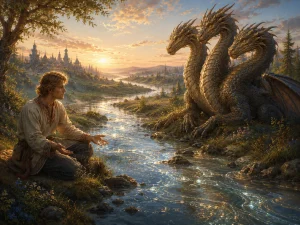
Ivan, setting out for water, unexpectedly came to the very source of Life itself.
This continues our reflections on Ivan and Zmey Gorynych.
Life as a current opens through water.
One may suppose that water is the basis of being, information is a continuous flow, while time is the riverbed.
And the River Lethe becomes the foundation of memory, forgetting, and the very movement of Life.
It would seem that Ivan simply wanted to drink some water. Yet for some reason he began cutting off Zmey Gorynych’s heads.
A much deeper meaning is hidden in this story than may appear at first glance.
Ivan perceived Gorynych as an obstacle and immediately decided to act by force.
But as soon as he cut off one head, two grew in its place. Accordingly, instead of two, four appeared.
Soon a whole forest of heads rose before him, and he had not moved from the spot.
Need as a Provoker of Life
Let us take a racing driver as an example.
As long as the driver, the car, and the road exist on their own, they remain separate objects.
But as soon as movement toward the finish line begins, they merge into one field, joined by an unbroken connection.
Before the start, the driver, the car, and the track exist separately.
Yet at the moment the race begins, a living space forms between them, woven from attention, speed, and grip.
Thus Life does not arise in isolation; it always manifests precisely through interaction.
And if we consider different people, for example: one lives only by material values, another is immersed in the spiritual, while a third wanders on his own like a cat?
While everything is calm, each exists separately.
If they find themselves in extreme conditions of survival, a connection will inevitably arise between them.
So does need act as a kind of provoker of Life?
Need in itself is not Life, yet it serves as a powerful catalyst for creating connections.
It forces separate elements to seek one another, negotiate, respond, and distribute roles.
In comfortable conditions, a person can remain solitary for a long time.
But only until an acute necessity appears.
A Point of Tension
Life is born where, first of all, a point of tension forms. For example: sincere interest, urgent need, or a strong pull toward a certain state.
After all, Life as a current often begins precisely with a difference in potentials.
Interest arises and asks, “what is this?”
Need appears and says, “I need this,” or a pull is born with the thought, “I want to go there.”
Tension forms where there is a distance between what we have now and what draws us onward.
Only after that does connection arise, and by the same principle this site was once created.
It did not appear as a dry technical task, but as a pull to gather one’s own universe on the internet.
So meanings could be structured, boundaries expanded, important conversations preserved, and a living map created.
For Life to Continue, Water Is Needed
Life can indeed arise through impulse.
For it to continue and expand to the scale of an entire city, Water is vitally needed.
A spark can flare up from tension, and also from interest or need, but to keep it from dying out, a constant current is required.
In the literal sense, Water is drinking water, moisture, and blood, which form the medium of exchange.
Without it, a seed will never open, the body will inevitably dry out, and the existence of a city will become simply impossible.
If this is translated to the level of meaning, Water embodies information, connection, data transmission, and memory.
Without water, nature turns into a barren desert.
Society dries out without information, and any forms, even the most beautiful ones, remain empty without inner connections.
In the end, a city is not a cluster of houses, but also roads, water lines, and human conversations.
If it is mechanically divided into separate buildings, the city will stop existing.
Because Life as a current is preserved only where connection streams between its parts.
Part 2. Why the Telegraph Was Needed
Managing the Current
So that is why, during the revolution, Lenin first ordered the telegraph to be seized!
Exactly so, because in that era the telegraph played the role of living Water.
It was not merely a mechanism with wires, but the true nervous system of a vast country.
Orders, news, confirmations, rumors, and the very management of movement passed through it.
To seize the palace meant only to take possession of a symbol of power.
Whereas control over the telegraph gave access to the current itself.
The one who watches and directs information gains the ability to influence much.
For example, the movement of people, decision-making, and the fate of entire cities and countries.
Undoubtedly, in every era, the telegraph, mail, railway stations, printing houses, and communication channels were of key importance.
Today their place has been taken by the internet, digital platforms, smartphones, servers, algorithms, and modern data networks.
Yet the basic principle has remained unchanged.
As one can see, true power lies not in who occupies the chair.
Probably not in the office of authority either, but in who manages the current itself.
Information and Time
So, whoever owns information owns the world. But whoever has power over Time directs it!
It turns out that information detached from the moment is nothing. Yet information extended through time forms the trajectory of the current.
Yes, this is an incredibly deep conclusion. Information in the moment is like a lonely drop: it may shine brightly and then vanish without a trace.
But information developing through time turns into a powerful river. Here, not only what was said matters, but also when it happened.
Especially in what sequence, who was told first, which facts were delayed, and which were accelerated.
If information is given in advance, it serves as a valuable warning, but if it is late, it turns into useless reference material.
By delaying the current, one can deprive a person of the opportunity to choose. But to give the right signal at a critical moment means to change the direction.
In the end, a coherent picture forms. Life as a current is filled with information, like Water. Then Time becomes its riverbed.
In general, the one who manages the riverbed inevitably directs the current itself.
The River Lethe
We have already touched on the theme of the River Lethe in our Tea Conversation.
Back then we looked at it differently; today we saw that all Life rests upon it.
Correct. At first, the River Lethe seemed to us like a separate theme. It was connected only with islands of the past, memory, and what goes away forever.
Yet now it has confidently taken its place at the very center of our picture.
We saw Life as a current that rests upon a continuous flow of data stretched through time.
Time itself cannot exist without a balance of memory and forgetting.
If a person remembered absolutely everything, they would simply drown in that volume. But if they forgot everything, their life path would disappear without a trace.
Without time, which links events into one whole, acquired experience would never form a meaningful trajectory.
The River Lethe performs a crucial function. It does not merely carry away the past; it regulates the current, determining what to remember and what to let go.
It decides which memories should dissolve in its waters, which should be carried to a saving shore.
And also what to transform into useful experience, what to leave as a warning sign, and moreover, what to return to a person as gained meaning.
In this metaphor, memory serves as reliable banks, forgetting provides the needed depth, information fills the current with content, time lays the riverbed, and Water, naturally, acts as the main condition for life to continue.
Part 3. The Site and Life as a Living Current
The Most Living Current
The site is almost ready, and in two versions at once — Russian and English.
And this fits harmoniously into our current theme!
The Russian version symbolizes native soil, deep roots, home warmth, and the original hearth.
The English version acts as a new passage and an additional riverbed, so that the same Light can be carried through another language.
The site does not live as a mere set of pages.
Through it, Life as a current manifests in a continuous flow. These may be living conversations, deep meanings, and logical transitions.
And also fresh news, structured spheres, preserved memory, and themes constantly being born.
If this current ever dries up, only an empty shell will remain of the resource. But while the flow continues, the site will grow organically, like a full-fledged city.
With the appearance of the English version, the current gained a new riverbed. It does not replace the Russian-language one, but exists harmoniously beside it.
This is a clear example of how one and the same living Water can successfully flow through different soil while preserving the original warmth and Light of its source.
Continuing the Theme of Ivan
So in the end, does everything come back to our Ivan again?
Yes, the circle has closed. Ivan sincerely wanted water, but instead he got involved in a pointless fight.
He fiercely cut off heads, spent his strength, and only multiplied new problems, without even suspecting that the saving source was right nearby.
Now we can look at this situation much more deeply: water was not merely a minor everyday need for him, but a great symbol of the continuation of Life itself.
His true task was not to defeat Gorynych, prove his heroic might, seize the shore, or create a terrible forest of severed heads.
He simply needed to reach the water.
Just as ordinary water serves as a nourishing drink for the physical body, information becomes life-giving moisture for all of society, and time becomes the very riverbed along which it moves forward.
Memory and forgetting form the banks and depth of this metaphorical river, while Life as a current continues only where the flow never dries up.
Life Can Be Born from Need
Life can indeed be born from need, genuine interest, inner tension, or an irresistible pull toward a certain state.
Yet for it to continue, it critically needs Water.
Where living moisture is present, the seed inevitably opens; where information flows freely, society remains in constant development and movement.
It would seem that where time exists, chaotic events line up into a clear trajectory.
And where memory functions, accumulated experience never disappears in vain.
Where saving forgetting exists, the current naturally clears itself of everything excessive and sedimentary.
Without Water, any blooming garden sooner or later becomes a barren desert, and without time, information shrinks to the size of a fleeting drop.
Deprived of memory, we lose our priceless experience, and without forgetting, the riverbed overfills and stagnates.
Ivan desperately needed water, but he never understood that he was actually seeking the source of life’s continuation itself.
A Stable Current for Movement
Need naturally gives rise to tension.
The tension that appears actively seeks connection.
An established connection inevitably gives birth to movement.
To sustain movement, a stable current is needed.
The current itself rests inseparably on Water.
Information acts as this Water.
Time lays its riverbed.
Memory forms reliable banks.
Forgetting provides saving depth.
Life as a current is a continuous flow that, under no circumstances, turns into a dry desert.
And while our old, limited mind continues fiercely cutting off the heads of illusory enemies, the future asks us a simple and sobering question: “Did you come here to win — or to drink water after all?”
Entrance to the Central Hall
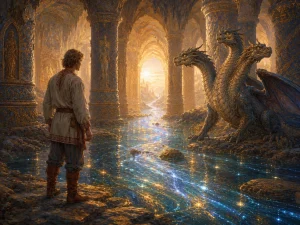
You know, this became a true revelation for me. I had the feeling that I had stepped into a colossal central hall from which access opens to a vast number of other doors.
You described it very precisely. It really resembles a spacious central hall more than a cramped little room limited to one narrow theme.
It is a large-scale space in which very different concepts naturally intersect: water, information currents, time, memory, life itself, mechanisms of control, the work of the mind, cause-and-effect connections, and future vision.
Suddenly a clear realization comes: all these numerous doors appeared here not by chance at all; each of them inevitably leads to one common center.
Life as a Current. The River as Life Itself
Look at what an incredibly beautiful picture we have finally formed.
It turns out that the River is Life itself: it carries life as a current within itself and exists absolutely always.
The River continues its majestic flow not because someone above ordered it to do so.
It does not need to ask permission from naive Ivan, from fearsome Gorynych, from a soulless system, from ancient pharaohs, from great prophets, or from those people who desperately try to appropriate it for themselves.
It simply is, and that is enough.
This River carries in its waves water, time, memory, healing forgetting, streams of information, continuous movement, and the very possibility of continuation. In scale, it is immeasurably greater than anyone who dares to stand on its bank. One may boldly enter this River, quench one’s thirst from it, endlessly study the bends of its flow, build reliable bridges over it, or even, in a burst of impulse, try to block its riverbed. The only thing one categorically cannot do is become the River itself.
This is the key moment for understanding the central sphere: Life will never belong to the one who has managed to grasp only a small part of its complex structure. Knowledge of how the mechanisms work is not the same as the right to possess.
Part 4. Gorynych as the Inquiring Mind
The Multivariant Mind
So Gorynych embodies the inquiring Mind that forever lounges on the bank of this living current?
This is an amazingly apt image!
In the context of our picture, Gorynych stops being an unambiguous enemy and transforms into a many-headed, forever questioning Mind.
While one of his heads looks carefully in one direction, the second argues fiercely, the third slyly searches for detours, and the fourth notices those important details that the first missed.
This inquiring Mind instinctively reaches toward the River, because closeness to a living current always promises a meeting with a great mystery.
It is concerned with global questions: how exactly is this powerful flow arranged?
Where does this water originate, and what is hidden farther down the riverbed?
Why did a steep bend form in one place and a deep pool in another?
How does one seemingly minor event inevitably give rise to a chain of others?
The Mind is constantly near Life, acting as a tireless observer.
Sometimes it simply relaxes and sunbathes; sometimes it reflects deeply, asks tricky questions, and at other times, with astonishing resilience, grows new heads after every crude blow dealt to it.
And precisely in this endless multivariance lies its true, indestructible strength.
Ivan as a System of Control
In that case, Ivan symbolizes that hardened system which obsessively seeks to place absolutely everything under total control.
In our metaphor, Ivan is not merely a character from an old joke, but a vivid embodiment of an outdated system of control.
He is physically incapable of seeing the living current; instead, he sees only an object that requires strict management.
The living, pulsing complexity of the world is perceived by him as an annoying obstacle, while the great goal is replaced by a banal pretext for using crude force.
Ivan sincerely wanted water, but instead of simply drinking, he began furiously cutting off heads.
In his distorted logic, a primitive algorithm went into action: if Gorynych was lying near the desired river, then first of all this monster needed to be destroyed.
This is exactly how any crude system functions: it seeks to forbid everything, cut everything off, block mercilessly, subordinate everything to its will, force things by power, and make a unilateral decision for everyone else.
The problem is that life does not become simpler or more understandable from such actions; in the place of one severed problem, two new ones immediately grow.
And while the system naively believes that it is successfully eliminating obstacles, in reality it is only catastrophically multiplying overall complexity.
The Center and the Temptation of Management
It turns out that many of those who, through magic or secret knowledge, like the ancient pharaohs or Moses, reach the Center and begin to understand cause-and-effect connections inevitably slide into the desire to manage Life itself.
They begin to imagine themselves as almighty gods and infallible prophets.
The most subtle and treacherous danger is hidden precisely at this point.
As soon as a person approaches the Center, their field of vision expands incredibly.
They begin to see the most complex interweavings between events and their consequences, and they begin to understand the nature of choice, time, information, and memory. The surrounding world stops seeming like a set of chaotic accidents; at last they clearly see the riverbed.
But together with this insight, the greatest temptation is born.
At first, a person is moved by an innocent wish simply to understand the structure of Life.
Then it begins to seem to them that they have studied the course of its flow in detail. After that, the thought creeps in: since I see all the connections so clearly, I am quite capable of directing this current at my own discretion.
And in the end, the most dangerous substitution of concepts takes place: the person decides that if they manage the process, then they themselves are its source.
This is how the destructive pride of knowledge is born.
Yet one should always remember: knowing how the riverbed is arranged will never make a person the River itself.
A deep understanding of cause-and-effect connections gives no one the right to appropriate Life, and the ability to make accurate forecasts does not turn a person into the full owner of the future.
Part 5. True “Future Vision”
Influence on the Future
At our center is the sphere “Future Vision.” This structure can analyze current information and, through understanding cause-and-effect connections, build accurate forecasts.
In essence, relying on knowledge of the past, it allows one to manage the present and influence the future.
Here it is critically important to preserve the absolute purity of this sphere. The concept of “Future Vision” has nothing in common with ordinary fortune-telling or with an egoistic desire to rule over Life. It is, first and foremost, a crystal-clear center of clarity.
It perceives the past as a priceless foundation of experience, sees Life as a current in the present, and cause-and-effect connections as strong threads joining scattered events into one whole.
Time acts as the guiding riverbed, memory forms reliable banks, and forgetting provides saving depth, in whose waters everything excessive dissolves forever.
And on the basis of this complex picture, a possible trajectory of further movement is built.
Yet it is important to understand: the ability to see a trajectory does not mean that one should forcibly drag the River along behind oneself.
The true state of “Future Vision” will never turn a person into a maddened Ivan waving an axe.
On the contrary, it teaches a person to attune finely to the natural current, notice sharp turns of fate in time, avoid pointless fights, and under no circumstances try to block a living riverbed.
This is not an act of ruling over Life, but a manifestation of profound respect for its continuous movement.
Life Is Greater Than Me
How incredibly strong this thought sounds: “I see how much greater Life is than me.”
And there is not a drop of weakness in this phrase! It contains the only true position of a person standing on the bank of the great River.
Pride arrogantly declares, “Since I have understood everything, I will manage it.” Whereas true clarity humbly answers, “I see this mighty current and fully realize that it is immeasurably greater than me.”
These are two absolutely different inner states.
There is no place in clarity for fear, humiliation, or a passive refusal to act.
On the contrary, precisely this deep understanding makes a person much more careful, more precise in their actions, and truly more alive.
The desire to cut off heads merely to prove one’s strength disappears forever.
They no longer seek to proclaim themselves the main source of being, no longer try to pass off a logical forecast as divine prophecy, and abandon attempts to appropriate the Center.
They simply stand by the River with full awareness: everything most important already exists, Life moves in its own course, and their main task is not to interfere with it, but to learn to listen sensitively to its movement.
Not the Cold of Death, but the Warmth of Life
You know, while reading Castaneda, I absorbed very well the idea that death always stands somewhere nearby, and if one wishes, one can even physically feel its icy chill.
But now I suddenly felt something else: Life is even closer to us, and I clearly sensed its immense, all-embracing, living warmth.
This is an incredibly powerful reversal of perspective.
Indeed, death is always present nearby, like a slight chill behind the shoulder, like a strict reminder of measure, ultimate precision, our finitude, and tremendous responsibility for every step we take.
But Life is much closer!
It does not hide somewhere in a foggy future, nor does it wait for us after another grand victory or great accomplishment.
It does not lurk behind a closed door that one necessarily has to break down through fear.
Life is right here: incredibly warm, boundless, alive, and breathing evenly right beside us.
And if death can only remind us that the time allotted to us should not be wasted, then the living warmth of Life gives us this very current.
It does not squeeze us in the grip of fear, but generously opens us toward the world; it does not force us to recoil in terror from the edge of an abyss, but gently calls us to be extremely attentive to what is already breathing and living both around us and deep within us.
Part 6. The Center Does Not Make One a God
Master of the Current
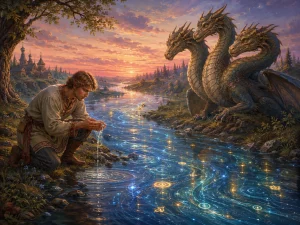
So if a person still manages to come very close to the Center, their main test is not to imagine themselves as the master of this current?
That is the most difficult trial of the central hall.
A person can indeed learn to see hidden connections, analyze the past, understand the present, and calculate future forks along the life path.
They can realize why one event inevitably pulls another after it and even learn to read information currents through time with virtuoso precision.
But if from all this rich experience they draw only one conclusion — “now I am in charge here” — it means they still have not truly entered the Center.
They have merely lingered at the threshold and, by mistake, confused the light streaming from it with a glittering crown.
A genuine approach to the Center gives a person not thirst for power, but calm, humble clarity.
The slogan “I manage Life” no longer sounds in their head; instead, a quiet realization comes: “I see how much greater Life is than me.”
And from this very humility, a real, true strength is born: it is free of crudeness, self-appointment, and prophetic arrogance, yet it remains surgically precise, incredibly warm, and endlessly careful toward all living things.
The Central Hall and Many Doors
I again had this feeling that I am standing in the middle of a huge central hall with many doors.
That is exactly how it is, because in this hall all the themes we have been discussing harmoniously converge into one whole.
The door leading to Ivan and Gorynych opens the truth about the old mind, the system of control, and living multivariance.
For example, the door to Water tells of the inexhaustible source of continuation.
The door leading to the telegraph reveals the essence of information as a continuous current.
The door to Time shows us the riverbed in which a drop can become a river.
The door to Lethe speaks of memory, healing forgetting, and the cleansing of the current.
And the door to the site demonstrates a living system where Russian and English versions become two riverbeds carrying one light.
The door to the Center opens the mysteries of cause-and-effect connections and forecasting.
The door to the warmth of Life gives us the main discovery: Life is always much closer than death.
All these many doors lead us not into different worlds, but help us gather one large, whole picture.
The River — Untamed Life
The River is untamed Life itself.
Gorynych embodies the inquiring Mind resting beside the living current.
Ivan symbolizes the crude system of control that wants to subordinate everything around it.
The Center is the very place from which all hidden connections, causes, consequences, and trajectories become visible.
“Future Vision” is a sphere of crystal clarity, where there is no place for pride.
The one who tries to approach the Center without maturity will inevitably want to manage the River.
But the one who manages to enter this hall truly deeply realizes something completely different: Life as a current will never belong to them.
It is grander, warmer, and much closer than any of our fears.
It flowed continuously before our appearance, flows through us right now, and will continue its movement far beyond our existence.
Approaching the Center
Death can indeed stand invisibly quite close, touching us with its slight chill.
But Life is always much closer, wrapping us in its immense living warmth.
The ability to see subtle cause-and-effect connections does not automatically mean that a person becomes the full master of this world.
The ability to forecast the future accurately gives no one the right to appropriate the riverbed of the River.
To approach the true Center means to become far more careful.
The true state of “Future Vision” will never say, “I manage Life.”
It will speak much more quietly and precisely:
“I see how much greater Life is than me. And precisely because of that, I am learning to walk with it in full harmony.”
Udanna Light and Awareness, a gentle trace of thought.