Architecture of Ether
Part 1. Spherical Clocks. Matter, Light, and the Wheel of Motion
Matter and Light
Thus, spherical clocks show more than the passage of time.
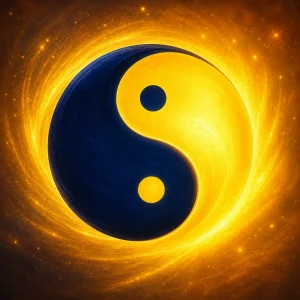
Alongside it, two equal principles rotate within them.
In general, indigo-blue is Matter.
It is material, body, labor, practice, weight, experience, and embodiment.
Yellow, meanwhile, is Light.
It is knowledge, information, thought, idea, order, and the image of a future form.
In theory, Light gives Matter direction.
It shows what can be created, where to move, and what form knowledge can take.
Matter, in turn, responds through labor.
It seems to receive the idea and test it through hands, weight, time, and a real result.
Yet the movement does not end there.
The Experience Gained Returns to Light
What was only a thought becomes tested knowledge.
Naturally, its errors, possibilities, boundaries, and new paths become visible.
Refined Light then pushes Matter toward the next action.
This is how the circle is born:
Light provides the intention.
Matter provides embodiment.
Embodiment, in turn, provides experience.
Experience refines Light.
Refined Light then begins a new circle.
Thus, one gives direction while the other gives form.
One illuminates, while the other tests.
Without Matter, Light would remain a possibility.
Without Light, Matter could labor endlessly without understanding its direction.
A Bridge Between the Parts
This is where the human being appears.
A person stands between Matter and Light.
Through the body, a person belongs to Matter.
They feel weight, fatigue, support, hunger, resistance, and movement.
Through thought, image, knowledge, and anticipation, however, a person receives Light.
These two principles meet within the person.
Light shows the direction.
Matter begins the movement.
Yet a person does not move like an arrow.
A person moves like a wheel.
Part 2. The Human Being as a Wheel
Living Motion
Imagine a coordinate axis. It usually seems that a person moves forward while facing ahead.
As though a straight line lies before them, and they simply need to look into the future and move toward the goal.
Living motion, however, is arranged differently.
A person chooses a direction, shifts weight, searches for support, and rolls from one point to another.
That is why a person resembles a wheel.
A wheel rotates around its center while advancing along the road.
It seems to repeat the same movement.
Yet every new turn touches a different point on the ground.
The same is true of a person.
They return again to familiar questions: trust, freedom, and boundaries.
But they return in another place and with different experience.
Therefore, circular motion does not mean standing still.
Each turn can become progress when the wheel has a center and a direction.
Center, Axis, and Direction
A wheel needs a center in order to move.
Without a center, it loses its shape.
It needs an axis.
Without an axis, rotation becomes unstable.
It also needs support.
Without contact with the ground, a wheel can spin but cannot advance.
Finally, it needs direction.
The person chooses where to direct the inner rotation.
Light may offer many ideas.
Matter may possess an enormous reserve of strength.
Movement begins when alignment appears between them.
What do I see, and what can I embody?
Where do I direct my next turn?
Why the Motion Goes Counterclockwise
Counterclockwise motion here need not be understood as moving backward.
It is a return to the source, the inner center, and the place where intention has not yet separated from living measure.
Ordinary clocks measure external time.
Inner Motion
Spherical clocks show inner motion.
What matters is not only: “How much time has passed?”
They also seem to ask:
“What became experience during this circle?”
“What did Matter return to Light?”
“How did knowledge change?”
“Where will the wheel now turn?”
Therefore, movement against the usual direction of the clock is not a rejection of the future.
It is a passage through the center before the next step.
How everything connects
Matter and Light rotate inside the spherical clocks.
Their rotation creates an impulse.
A person receives this impulse, chooses a direction, and moves as a wheel.
A single mechanism emerges:
Light gives birth to an image.
Matter embodies it.
Experience returns knowledge.
The person chooses a direction.
The wheel makes a new turn.
Then spherical clocks become not an instrument for measuring time, but a map of development.
They show not how much has been lived, but what has passed through labor.
They also show not how much has been learned, but what has received form.
Finally, they show not how many turns have been completed, but how far the center has advanced.
Exchange of Impulses
A person does not fly into the future like an arrow.
A person moves as a wheel.
Within them, Light and Matter continuously exchange impulses.
Light gives direction.
Matter responds through labor.
Labor gives birth to experience.
Experience refines Light.
The person chooses where the next circle will roll.
Spherical clocks show the living rotation of Matter and Light.
The human being becomes the wheel of this rotation.
They move around the center, yet with every turn enter a new point of Life.
Rotation creates the possibility of movement, but the person chooses the direction.
Udanna Light and Awareness, the pages remain connected.