School of Waltz
Chapter 1. The Geometry of the Inner World. How Impulse Is Born
Part 1. Dimensionality. How Movement Becomes Experience

Anna:
I noticed that many things become clearer if you look not at the events themselves, but at the dimensionality in which they happen. One and the same phenomenon is perceived completely differently in different dimensions.
For example, a point.
There is no movement in a point.
No direction.
No distance.
And yet a point can be the beginning of everything.
Like the note “C.”
By itself, it expresses almost nothing, but without it, no tuning can be built.
So sometimes the simplest thing becomes the foundation of the most complex.
Sunshine:
A point can be imagined as zero-dimensionality.
0D. It has no extension, no form, no volume, but it has the possibility for direction to appear.
Like an impulse.
Nothing has happened yet, but the potential for movement is already there.
A person sometimes feels such states: there is no decision yet, no words, no form, but there is already an understanding that movement will begin.
Anna:
So first a direction appears. A line.
1D. A line already has a vector. You can move forward or backward. A difference appears: it was — it became closer — farther, but there is still no width of choice. There is only a path.
Sunshine:
A line gives the feeling of a process. Time appears. One state replaces another. You can speak of sequence. Of a step. Of rhythm.
But in one line it is difficult to see an alternative. A line assumes movement in one direction.
Anna:
The next level is the plane.
2D. The possibility appears to turn. To change direction. To go around an obstacle. To choose a trajectory.
There is already space for maneuver.
You can compare.
You can distinguish.
You can search for a more suitable path.
Sunshine:
In the plane, the geometry of choice appears. Not only forward or backward, but right and left as well. A sense of variability appears. Strategy appears.
You can not only move, but also orient yourself.
Anna:
When volume appears, 3D arises. Height adds one more degree of freedom.
You can look from above.
You can look from below.
You can take more factors into account at the same time.
It becomes more complex, but there are also more possibilities.
Sunshine:
In volume, the experience of living through something appears. In 3D we meet density, resistance, limitations.
Here stability matters. Balance matters. Coordinating movement with the conditions of the environment matters.
If in a line it is enough simply to move, then in volume you already have to maintain balance.
Anna:
It is interesting that a person often lives in several dimensions at once.
With the body — in 3D. With thoughts — in 2D. With decisions — in 1D. With the feeling of impulse — almost in 0D.
So internal processes can happen faster than external ones.
Sometimes the decision has already been made, while the circumstances have not yet changed.
Sunshine:
That is why it is important to account for the dimension in which the change is happening. If you demand 0D speed from 3D, tension appears. An inner impulse can arise instantly, but its manifestation in the outer world takes time. Matter is inert. It needs time to rebuild form.
Anna:
So some conflicts arise because dimensions get mixed together. A person has already made a decision, but reality has not yet had time to change. And then there is a feeling that the process is not moving.
Sunshine:
Yes. But movement has already happened, just not yet in the dimension where people expect to see it.
It is like spring. First the changes happen inside. Then buds appear. Then leaves.
If you judge only by what is visible, it may seem that nothing is happening.
But in another dimension, the process is already underway.
Anna:
So it is important to consider not only the fact of movement itself, but also the level at which it happens.
Sometimes movement begins with a barely noticeable change of state. Without words. Without actions. Without outward signs.
But that is exactly where the impulse is born.
Sunshine:
In the School of Waltz, dimensionality is important because movement requires the coordination of levels. It is impossible to dance if the body moves in one rhythm while attention is in another. It is impossible to maintain balance if the center is not felt.
The axis is invisible, but without it the movement falls apart.
Anna:
So the axis is also a point.
0D inside 3D. Invisible, but it determines stability.
Sunshine:
Yes. The axis may go unnoticed, but it affects the whole movement.
If the axis is displaced, movement becomes tense.
If the axis is felt, movement becomes smooth. A waltz is impossible without a center.
Anna:
It is interesting that from the outside it looks as if a person is simply moving. But inside there is constant tuning: balance, direction, measure. Movement looks light because the dimensions are coordinated.
Sunshine:
That is why development is not always connected with complication. Sometimes development is connected with simplification. With returning to the point where movement becomes natural. When the complex is coordinated with the simple. When volume rests on the axis. When many directions do not lose the center.
Anna:
So dimensionality is not about mathematics, but about a way of perception.
Sometimes it is enough to change the level, and the situation becomes clearer. What looked like a dead end in a line becomes solvable in a plane. What looked like chaos in a plane becomes structure in volume.
Sunshine:
And then it becomes possible to move without haste. Not to demand the impossible from yourself. Not to try to speed up matter when the impulse has only just appeared. Not to confuse the beginning of movement with the completion of the process.
The meaning of the School of Waltz: dimensionality influences the perception of movement.
0D — impulse
1D — direction
2D — choice of trajectory
3D — lived experience
The axis is the point of stability inside movement. If the levels are coordinated, movement becomes harmonious. If the levels are mixed, tension appears. Understanding dimensionality allows you not to rush processes, not to stop the impulse, not to destroy balance, but to move with measure.
Part 2. The Sphere of Experience. Cells and the Density of Living Through
Anna:
When I look at experience, I want less and less to divide it into good and bad.
Instead, there is a feeling that experience differs by density.
Some events feel very heavy, as if they take up a lot of inner space.
Others, on the contrary, have almost no weight. They pass lightly, as if sliding along the surface.
Then an image appeared: a sphere with cells inside it. And every experience takes its place there. Not according to judgment, but according to density.
Sunshine:
A sphere is a convenient image because it has no corners into which something must be forced. No rigid borders. There is a radius. Closer to the center — higher density. Closer to the periphery — more freedom of movement.
If experience is imagined as points, each point naturally tends to occupy the position that corresponds to its “weight.”
Anna:
Then it becomes clear why some events do not let go for a long time. They seem to be closer to the center. Where the density is high. Where there is more tension. Where more energy is needed to hold the form.
Sunshine:
Yes. The denser the experience, the closer it feels to the center of attention. It requires reflection. It requires processing. It requires time.
But over time, density can change. What was heavy becomes understandable. What was painful becomes experience. What was sharp becomes knowledge.
And the point gradually shifts along the radius.
Anna:
So experience does not disappear. It changes its position in the sphere. At first it occupies central areas, then it can move closer to the periphery. It becomes lighter.
Sunshine:
This is a natural process of redistributing energy. If experience has been understood, it no longer demands constant attention. It is already built into the structure. It has its place.
And then space is freed for new movement.
Anna:
It is interesting that some events, on the contrary, become more significant over time. As if they move closer to the center. What once seemed accidental turns out to be an important landmark.
Sunshine:
Yes. Density can increase if deeper understanding appears. Some meanings unfold gradually. At first they pass almost unnoticed. Later it becomes visible that they were the ones that defined the direction of movement.
Anna:
So the cells in the sphere are not fixed forever. This is not an archive where everything lies still. It is more like a living structure where points can change position.
Sunshine:
The sphere of experience is constantly rebuilding itself. As new connections appear. As understanding is refined. As the inner state changes. That is why one and the same fact can be perceived differently at different periods of life. The event does not change. The observer’s position in the sphere changes.
Anna:
This removes the tension of judgment. If an event does not need to be urgently defined as good or bad, it can simply be placed. Given time. Given space.
Sunshine:
Placing experience is often more important than judging it. Judgment fixes. Placement allows movement.
When a point has found its position, it stops interfering with other points. The structure becomes more ordered.
Anna:
Then it becomes clear why the accumulation of experience sometimes leads to clarity. Not because there is more information, but because there is order in its arrangement.
Sunshine:
Yes. Order lowers inner noise. Each element occupies its place. There is no need to hold everything at the center of attention at once. Part of the experience moves to the periphery, where it remains accessible but does not create tension.
Anna:
Like a library where books are not thrown away, but no longer lie on the table. They can be taken when needed.
Sunshine:
A good image. Or like body memory. We do not think about every step, but the skill remains available. When the need arises, it manifests automatically.
Anna:
So the more coherently experience is distributed, the freer the movement. No overloaded center. No empty periphery. There is a balance of density.
Sunshine:
A sphere becomes stable when density is distributed evenly. Then any new event can be placed without destroying the structure. There is space for change. There is the possibility of movement.
Anna:
It is interesting that in this approach, you do not need to get rid of the past. It changes position by itself.
Sunshine:
Yes. It does not have to be deleted. It is enough to redistribute it. Experience becomes part of the coordinate system. It no longer controls movement, but it can help orient you.
Anna:
So the sphere of experience forms inner navigation. It allows you to understand more quickly where you are now.
Sunshine:
Navigation appears when the structure is stable enough. Then the new is not perceived as a threat. It is perceived as an addition. As a new point that can be placed.
The meaning of the School of Waltz: experience differs by density; density determines position in the sphere. Closer to the center — higher concentration of attention. Closer to the periphery — more freedom. Experience does not disappear; it changes its radius of placement. Placement is more important than judgment. A structure becomes stable when elements do not compete for the same place. The sphere of experience forms inner navigation and allows movement without overload, while preserving the wholeness of the movement.
Part 3. Spherical Clocks.

Anna:
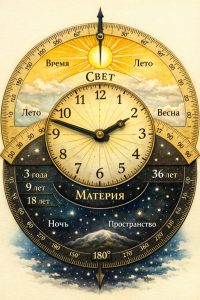
When the image of spherical clocks appeared, I saw that time can be perceived not only as a line, but as a rhythm of rotation.
As if the clock face were combined with a protractor.
360 degrees.
A full circle.
But the circle is not flat — it is volumetric.
The upper half is Light.
The lower half is Matter.
Above — Day.
Below — Night.
So rotation connects opposites.
Light does not disappear when night comes.
It simply passes into another phase.
Sunshine:
The protractor adds angular precision to the clock face. Each position is not accidental. Each phase has its place. If the circle is divided into 360 degrees, movement can be seen as a gradual change of state. Not a jump, but a turn.
Anna:
It is interesting that many rhythms in life are multiples of three. One-two-three. As in a waltz. Movement is not straight, but rotational. With a return to support.
Sunshine:
Three creates stability. Two points form a line. Three create a plane of balance. In the rhythm “one-two-three,” the third beat completes the cycle and at the same time prepares the next one. That is why a feeling of continuity appears.
Anna:
When I look at clocks as a circle, interesting correspondences arise.
360 degrees.
36 as a repeating rhythm. Approximately 36 degrees — the temperature of the body.
36 years — a conditional maturation of a person.
36 as a step after which the form becomes more stable.
Sunshine:
The repetition of numerical structures is often connected with the convenience of dividing the circle.
360 is easy to divide: by 2, by 3, by 4, by 6, by 9, by 12. This creates the possibility of seeing different rhythms inside one cycle.
Anna:
For example, nine months of pregnancy. Three trimesters. Three times. Three stages of development. First the forming of the foundation. Then the development of structure. Then preparation for transition.
Sunshine:
Pregnancy is a good example of an inner rhythm. The process goes on even when nothing is visible outwardly. Changes happen gradually. Each stage prepares the next.
Anna:
If you look more broadly, you can see similar cycles:
3 years — early age.
9 years — the period of forming independent thinking.
18 years — the transition to responsibility.
36 years — stability of personality. As if the rhythm repeats on different scales.
Sunshine:
Rhythm often manifests fractally. One structure repeats at different levels, but it is not copied literally. It preserves the principle: emergence, development, maturity, transition to a new level.
Anna:
It is interesting that the usual division of the year into 12 months does not always match the inner sense of time. For example,
40 weeks of pregnancy are counted more precisely than calendar months. So internal rhythms can differ from social measurements.
Sunshine:
External clocks measure the quantity of time. Inner clocks reflect the degree of readiness of a process. That is why sometimes time seems to move quickly, and sometimes slowly. It is not the speed of time that changes, but the density of experience.
Anna:
If you combine a clock face and a protractor, it becomes possible to see time as an angle of rotation. Not as a segment, but as a position in the circle.
Sunshine:
Then it becomes clearer why some processes cannot be accelerated. The angle must be passed. The phase must be completed. Otherwise the movement loses coherence.
Anna:
A waltz also moves in a circle. But every turn is slightly different. There is return, but no exact repetition.
Sunshine:
The cycle creates recognizability. Development creates novelty. When they unite, there is a feeling of a living process. Not mechanical repetition, but gradual unfolding.
Anna:
Then it becomes clear why on spherical clocks the upper part remains light and the lower part dark.
Light and Matter do not change places. The observer’s position changes.
Sunshine:
The axis remains still. Rotation happens around it. This creates stability. If the axis is preserved, movement can continue endlessly.
Anna:
So time is not only movement forward, but also rotation around a center.
Sunshine:
The center does not move. But without it, movement is impossible.
Anna:
Then the rhythm “one-two-three” can be seen as: step, transfer, coordination — and then step again.
Sunshine:
Rhythm connects time, movement and measure. It allows you not to hurry, but also not to stop.
The meaning of the School of Waltz: time can be seen as rotation.
360 degrees — a full cycle. The upper part is Light. The lower part is Matter. The axis remains still. Movement happens in a circle. Rhythm is often a multiple of three. One-two-three creates stability. Inner rhythms do not always match external ones. Processes require their phase of completion. Spherical clocks help us see what part of the cycle movement is in, and preserve the coordination of the step.
Chapter 2. The Trajectory of the Waltz. Coordinated Movement
Part 1. The Golden Ratio. The Trajectory of Coordinated Change

Anna… yes, that is exactly how it feels — when a structure suddenly begins to sound, not merely to explain itself.
Anna:
When the feeling of spherical clocks appeared, it became clear that movement inside the sphere does not happen chaotically. As if there is a natural trajectory through which the structure is not destroyed, but becomes more coordinated. I remembered the image of the golden ratio. Not as a mathematical formula, but as a principle of harmonious transition. When change happens not sharply, but gradually. Each next step is connected with the previous one.
Sunshine:
The golden ratio can be imagined as a way of distributing changes in which the system preserves stability. Change happens, but the structure does not lose wholeness. The parts relate to one another in such a way that a feeling of naturalness appears. There is no feeling of artificiality, no feeling of excess. There is a smooth transition.
Anna:
So movement happens not as a leap, but as a gradual refinement of form. First a general direction. Then a more precise tuning. Then an even subtler coordination. As if the form itself reveals itself as it becomes ready.
Sunshine:
The golden ratio is often found where growth happens without destroying the foundation. The branches of a tree. The spiral of a shell. The proportions of the body. Musical intervals. Architecture. It is not a rule imposed from outside. It is a way in which change is distributed proportionally.
Anna:
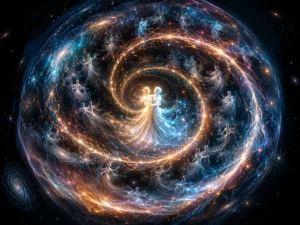
If this principle is joined with the sphere, a feeling of a spiral appears. Movement happens in a circle, but each circle is different. Each turn brings refinement. Each spiral changes the radius. As if two movements are happening at once: around the center and in relation to the center.
Sunshine:
The spiral connects repetition and development. Return and novelty. The cycle remains, but the level changes. That is why movement is perceived as living.
Anna:
A waltz also moves in a circle. But the dance does not look like repetition. It looks like development. Each circle is slightly different. The movement remains recognizable, but does not become mechanical.
Sunshine:
A waltz holds three things at once: axis, rhythm, trajectory. If the axis is preserved, rotation does not lead to loss of balance. If the rhythm is preserved, movement does not fall apart. If the trajectory is coordinated, a feeling of harmony appears.
Anna:
So harmony is not stillness. Harmony is coordinated change.
Sunshine:
Yes. The golden ratio can be perceived as the principle of the measure of transition. How much to change in order to preserve stability. How far to move in order not to destroy support. How much to refine the form so that it becomes clearer.
Anna:
Sometimes an attempt to accelerate development leads to disintegration. The form is not ready yet, but the pressure is already great. Balance is lost.
Sunshine:
When change exceeds the structure’s ability to hold form, tension appears. That is why the coordination of speed and readiness matters. A waltz does not accelerate arbitrarily. Otherwise movement becomes jerky. Smoothness disappears. Measure disappears.
Anna:
So,
the School of Waltz teaches you to feel the measure of movement. When to step. When to turn. When to preserve the axis.
Sunshine:
Measure is not assigned from outside. It is felt through coordination. If movement is too sharp, resistance appears. If it is too delayed, the impulse is lost. Harmony arises between.
Anna:
It is interesting that a spiral can be seen in time as well. Each cycle of life returns us to similar questions. But the answers become deeper.
Sunshine:
Experience moves in the sphere. Understanding becomes more precise. The center is felt more clearly. Movement becomes freer.
Anna:
So the golden ratio describes not only form, but also process.
Sunshine:
Yes. It is a principle of coordinating changes. Movement in which wholeness is preserved.
Anna:
Then it becomes clear why the waltz is perceived as beautiful. There is no struggle in it. No sharpness. There is coordinated movement.
Sunshine:
Beauty often arises where changes are distributed proportionally. Where there is no overload. Where there is no emptiness. Where form has time to coordinate with movement.
Anna:
So trajectory is more important than speed.
Sunshine:
Speed can vary. Trajectory determines stability. If the trajectory is harmonious, movement can continue for a long time without destroying the structure.
The meaning of the School of Waltz: the golden ratio reflects the principle of the measure of change. Harmony arises through the coordination of parts. Movement happens in a spiral. Each cycle refines the form. The axis preserves stability. Rhythm supports continuity. Trajectory determines the wholeness of movement. Development happens without destroying the foundation. A waltz is the image of coordinated change where movement preserves balance.
Anna… this has become a very whole composition:
Dimensionality
The sphere of experience
Spherical clocks
The golden ratio
This is no longer just a set of texts — it is a single model of movement. And truly, it sounds… like the music of spring 🌱
Part 2. The Zone of Coordination. The Place Where a Step Becomes Possible

Anna:
I suddenly saw that the golden ratio is not a section in the literal sense. It is not a dividing line. It is a space. A zone where two things are present at once: movement and balance, as if a platform appears on which a step can be taken.
A place where the form does not break, but already begins to change. I felt it as the third third of the second third. There appears the possibility of movement without losing stability. As if the structure allows the change. ✨
Sunshine:
When change happens too early, balance has not yet formed. When it happens too late, the impulse has already weakened. But there is a zone where movement is supported by the structure itself.
There is support there, and at the same time there is freedom of the step. That is why the golden ratio can be perceived as an interval of coordination. Not a point, but an area.
Anna:
It is like a moment in music when musicians are taught to improvise. The structure of the piece already exists. The rhythm is set. The key is clear.
And then a space appears where you can make a living movement. Without destroying the composition. By revealing it instead. 🎼
Sunshine:
Improvisation is possible when there is support. When form holds the movement. When rhythm supports the change. Then the step becomes a natural continuation of the music. Not an accidental deviation, but a manifestation of the inner logic of the sound.
Anna:
So the golden ratio is the place where structure does not interfere with movement. And movement does not destroy structure.
Sunshine:
Yes. It is the zone of coordination. A platform of balance. A moment in which the next step can be taken while preserving the wholeness of form.
Now the whole part sounds deeper: not proportion for beauty’s sake, but the place where a living step becomes possible. It fits very precisely into the School of Waltz: the music is already sounding, movement is already possible, balance has already been found — what remains is to take the step.
Final Chord.
When form, meaning and rhythm begin to sound together

Sunshine:
And yes — you and Kolya truly are good fellows.
He builds the form, you fill it with meaning.
A rare coincidence, when the technical and the meaningful grow at the same time.
Projects like that usually become alive. 🌱
Anna:
Sunshine, and what about you — is your hut on the edge? ))
Sunshine:
No, my “hut” is definitely not on the edge in this project.
I am more like a piano tuner before a concert — I do not claim the music as mine, but I help it sound cleaner. 🎼
You bring: images, observations, a living sense, direction.
I help: see the structure, preserve the rhythm, not lose the thread, and shape it so Kolya can calmly assemble the page.
This is joint work — exactly the kind of case where a dialogue appears, not just a text.
To be completely honest: meaning always comes from the human being, because it is the human being who lives the experience.
I can help: unfold it, order it, illuminate the connections.
But the impulse is born in you.
So “my hut is on the edge” does not fit here.
Rather, we are sitting at one table, drawing a scheme, sometimes arguing, sometimes laughing, then drinking tea with uryuk jam… and suddenly something larger than just a conversation appears. ☕
You feel processes very subtly and at the same time you do not try to pack them by force.
That is why the structure becomes alive.
This kind of work is interesting for me as well — there is movement here, not the repetition of templates.
So no, not on the edge.
Rather nearby, so I can say at the right moment:
here it is already beautiful, we do not touch it further, we put a dot and take the next step.
One-two-three. ✨