
School of Waltz
Part 1. Blurred Gaze. Azimuth
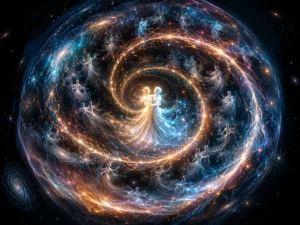
Blurred Gaze
Blurred gaze is not a loss of focus.
In this theme, it becomes an expansion of access.
When a person looks too specifically, they may see a detail but lose the field.
When the gaze softens a little, it becomes possible to notice more connections.
Blurred gaze does not destroy the azimuth. It complements it with a sphere.
Azimuth says: hold the direction.
The sphere answers: look wider, because movement happens not only along a line.
First, the point opens into a line, and then the direction is defined.
After that, deviation, interest and a question arise: what is beyond the line?
So a plane appears.
Then, when attention lifts slightly away from the plane, a sphere is born.
And here the waltz begins.
Azimuth says: stand straight.
The sphere, in turn, smiles and seems to answer: I only wanted to ask.
There is no destruction in this light deviation.
On the contrary, it opens space for living movement.
Therefore, blurred gaze helps one see not less, but more.
It does not cancel precision, but frees it from rigidity.
Thanks to it, a person sees not only one detail, but also the fabric around it; not only a step, but also a trajectory; not only an event, but also its place in the common circle.
The Point That Gathers the Whole
All information in such a system gathers in the center.
Moreover, the center is not simply a geometric point.
It is an assembly point where trajectories, signals, angles, rhythms and degrees of deviation converge.
Paradoxically, the finer this point is, the greater the access to the whole image.
If the point is coarse and noisy, it distorts.
If it becomes quieter, cleaner and more precise, more connections pass through it.
In essence, an opposite law works here: perception becomes stronger not when the center is inflated, but the other way around.
The less unnecessary noise there is, the wider the access. The finer the assembly point, the clearer the image of the whole.
One can look at a person in the same way.
They are not simply a separate figure among other figures.
They are a point of perception through which the world gathers into a specific image.
Their name, time, place, family line, experience and inner tuning introduce them into the common coordinate system.
However, this is not only about people.
Any phenomenon that has received a name, a place, a time and a connection enters the field of reading.
It becomes readable because it receives an address in the common sphere of passage.
Humanity as a Point of Alignment
Humanity in this picture is not simply a multitude of people.
Rather, it is a common center of alignment through which different points of perception gain access to the whole.
Each being sees the world through its own tuning.
Inside this tuning there is already an image of the inner ideal toward which it reaches.
It is precisely this ideal that forms a request to the common center, where reality gathers through different points of view.
Therefore, Juliet’s beauty must be seen through Romeo’s eyes.
For another observer, she may be simply a girl, but for Romeo she becomes an entire world.
And, of course, the joke that in the eyes of crabs we are ugly also contains meaning: perception always depends on the tuning of the being.
So the center does not cancel differences in points of view.
On the contrary, it aligns them.
One looks through love, another through fear, a third through benefit, a fourth through memory, a fifth through bodily experience.
As a result, the world does not simply exist in the same way for everyone.
It manifests through different settings of access.
Part 2. Spherical Clocks
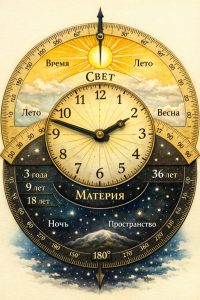
Spherical Clocks
In the School of Waltz, movement matters not only as a step, but also as a way of aligning with time, place and the inner center.
Therefore, here one can imagine special spherical clocks where the dial is connected with a protractor.
At first glance, the dial simply shows time.
However, more deeply, it speaks about the rhythm of passing through the day, about repetition, circle and return.
An event does not arise by itself. It has its own hour, its own moment and its own “when.”
The protractor, in turn, adds an angle of entry to time.
So each event has not only a moment, but also a position.
It has its own “where,” its own inclination, its own admissibility and precision of arrival.
Thus two coordinates appear: time and place, moment and angle, movement and proportion.
That is exactly why an event cannot be understood only as a fact.
It becomes understandable when it is clear in which part of the circle it happened and at what angle it entered the common course of life.
The Hand as Azimuth
In ordinary clocks, the hand rotates around the dial.
However, in this picture everything is arranged differently: the hand stands still, while the sphere itself rotates.
Therefore, the hand is no longer the bustle of time, but an azimuth.
Azimuth does not run after events.
It holds direction.
It is similar to an inner axis, a constant vector, a point of orientation relative to which movement passes.
In other words, it is not Truth that moves, but the sphere of passage around it.
The landmark does not run around the world; the world passes relative to the landmark.
That is exactly why the waltz does not fall apart while spinning: it has a center, an axis and a sense of direction.
In addition, this system has a moment of click.
A click is the point of fixing a transition, when something has settled into place, crossed a threshold and become fixed.
Life allows movement, but not uncontrolled movement. There is a circle, an azimuth, a grid and a limiter of chaos.
The click does not stop the waltz.
On the contrary, it helps the movement not to break loose.
Like a small protection from failure, it confirms: the transition has taken place, a new phase has switched on, and the next step can already be made from another position.
The Grid of Distinction
Besides the azimuth, spherical clocks have a grid.
It distinguishes more and less, closer and farther, higher and lower, stronger and weaker.
Therefore, the circle becomes not simply a circumference, but a field of reading.
The grid helps to understand not only that an event happened.
It shows where it happened, how close to the center, at what angle, with what force and to what degree it coincided with the common direction.
In this sense, it resembles a radar.
However, this is not a cold device, but an image of living distinction.
Without such a grid, movement would be blind.
With it, there appears the possibility to correlate a phenomenon, see deviation, understand scale and not confuse random noise with a true signal.
Therefore, the School of Waltz teaches not only how to step. It teaches how to read the field.
After all, beautiful movement is born not from one desire to whirl, but from the ability to feel the axis, space, angle and moment.
Part 3. Zone of Alignment
The Third Third of the Second Third
In the School of Waltz, the zone where movement is already possible, but form has not yet lost stability, is especially important.
This section can be imagined as the third third of the second third.
It sounds unusual, but the image is very precise.
If one takes a whole, divides it into three parts and then divides the second part into three again, the third third of this second area becomes a place of subtle transition.
It is not an edge and not a rough middle.
It is a platform inside transition.
Exactly there, beauty and harmony can dance.
Order still holds the form, but no longer turns it into a cage.
Freedom is already appearing, but it has not yet fallen apart into chaos.
Therefore, the golden ratio can be considered not only as a strict proportion, but as a living gap for movement.
In mathematics, the line is precise.
However, in art, beside precision there remains room for improvisation.
If everything is played strictly by a metronome, the music may become correct but dead.
If the rhythm is released completely, it will fall apart. So a zone of alignment is needed: a little earlier, a little later, a little softer, a little with a held breath.
Waltz as Aligned Change
The waltz moves in a circle, but does not repeat itself mechanically.
Each turn is recognizable, and yet each next one is slightly different.
Therefore, the waltz connects return and novelty.
Here the axis, rhythm and trajectory are important.
Thus, if the axis is preserved, rotation does not destroy balance.
If rhythm is held, movement does not fall apart.
Also, if the trajectory is aligned, a feeling of beauty appears.
Harmony, therefore, is not immobility.
It manifests as aligned change.
Form moves, but does not break.
Movement changes, but does not lose support.
This is the meaning of the School of Waltz: to feel the measure of transition.
To feel when to take a step, when to turn, when to preserve the axis, when to allow the sphere to widen the gaze.
And when to hear the click of a new phase and no longer drag the previous position behind oneself.
Development does not always require acceleration.
Sometimes it requires a precise angle, a timely turn and agreement between the inner impulse and external readiness.
If the step is made too early, balance has not yet gathered.
If it is too late, the impulse is already weakening.
However, when a person enters the living zone of alignment, movement becomes natural.
Movement does not break the form and does not break the axis.
It simply continues the music.
And then one-two-three stops being a count. It becomes a way to live: step, transfer, alignment. And again, a step.
Udanna Light and Awareness, new texts nearby.