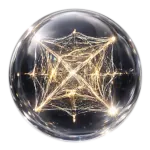
Architecture of Ether
Part 1. No King in the Head: Center, Weight, and the Note of Connection

A manager is not a king
People say this about someone: “There is no king in his head.”
In general, it is understood simply: the person is scattered, reckless, strange, or a little foolish.
But the meaning here is much deeper.
No king in the head is probably not about a lack of intelligence.
Most likely, it is about the absence of an inner center.
Of course, a person can have thoughts, fears, habits, memory, interests, resentments, will, and experience. In a sense, a whole state of different voices can live inside.
But if there is no center that holds the weight of the person, this state begins to make noise by itself.
Then each part pulls in its own direction.
Fear demands caution, resentment demands revenge in its own turn, desire demands immediate pleasure.
Pride most likely demands victory or recognition, habit demands repetition, and someone else’s opinion demands submission.
Naturally, the person is sure that he thinks, decides, and acts on his own.
But if there is no center, then there is no one who holds the whole together.
That is when the state of having no king in the head appears.
When the cockroaches declare a republic
When asked “what does it mean to have no king in the head?”, Kolya answered incredibly funny and precisely:
“When there is no king in the head, cockroaches move in.”
And perhaps there was more meaning in this joke than it seems.
As the saying goes, a holy place never stays empty.
If there is no king in the center, then small, pot-bellied fuss moves in there. That means anxieties, suspicions, resentments, random thoughts, other people’s judgments, strange scenarios, and “what if.”
In essence, these are the inner cockroaches.
So they run around there as if it were their own house, rustle, and multiply in the dark.
As usual, they pretend to be holding an important meeting.
Yet cockroaches do not hold the weight of a person.
They only scatter his attention into the corners.
But the King would gather everything into one whole.
That is why a person with no king in the head is a person without weight.
Weight as foundation, the King as the holder of weight
Weight does not appear at once.
At first something sounds like a desire, a thought, an experience, or an event.
Then time passes. The unnecessary settles, the accidental leaves, and the real remains.
That is how foundations are born.
What has settled, what has stood firm, what has been established, what has become unshakable like a mountain.
Therefore, weight is not crude heaviness. It is a support tested by time.
The King is the weight of foundations.
A person’s inner king also does not hold every random thought, but what has become a basis.
The king in the head holds measure, conscience, memory, experience, love, responsibility, and living truth.
Weight is time that has become support.
The king is not a manager.
A manager holds processes: deadlines, tasks, instructions, control, order, and execution.
But the king holds the weight of the whole.
That is why even an infant can be king.
He does not yet govern a state, write decrees, lead an army, or understand the treasury.
Yet an axis already gathers around him.
He becomes the point on which succession, right, responsibility, and the shared weight of a people rest.
The same happens inside a person.
The mind can manage.
Logic can explain.
Will can force.
Memory can prompt.
Habit can lead.
Emotion can flare up.
But none of this is the king yet.
The king in the head is the inner center that holds the weight of the whole person.
He does not command every thought.
He holds the whole together.
Part 2. The Manager and the Inner King
Inner alignment
A mind without a center can be very skillful.
It knows how to explain, justify, prove, argue, and find beautiful reasons.
But if there is no king inside, the mind quickly begins to serve whoever rustles the loudest.
Today it justifies fear.
Tomorrow it serves resentment.
Then it builds plans for pride.
After that it explains why the person has once again followed someone else’s opinion.
It turns out that there is a manager, but there is no king.
The mechanism works.
But no one holds the weight of the whole.
This happens with a person, with a state, and with any system.
If only administrators remain, processes can move quickly and even efficiently.
But without a living center, the system begins to lose its inner head.
Outwardly, there is order.
Inside, there is no alignment.
The inner state of a person
A person is not one flat thought.
Inside him there is a whole people.
There is the body with its signals, memory with its traces, and, without doubt, fear with its caution.
Naturally, there is interest with its direction, and also pain with its warning.
There is certainly joy with its light, moreover will with its effort.
And also love with its attraction.
Each part is important in its own way.
The problem does not begin when there are many parts.
The problem begins when they stop hearing the center.
Then fear becomes the ruler.
Resentment becomes the law.
Desire becomes the order.
Thought becomes noise.
The body becomes a forgotten basement.
Memory turns into an archive with open doors.
And the person loses weight.
He rushes forward, then gets frightened, then grows angry, then justifies himself, then follows someone else’s voice, then gathers himself piece by piece again.
This is the inner state with no king in the head.
A note with weight
But the king is not needed in order to silence everyone.
He is needed in order to hear and distinguish.
Because not every thought carries meaning.
There is noise.
And there is a note.
A note differs from noise because it has weight.
It may be quiet, but it is impossible not to hear it if the connection is alive.
An infant cannot write a demand on paper. He cannot explain his position, present arguments, or compose a diplomatic note.
But he can sound such a note that the whole house changes its movement.
And it is not always about volume.
A television may roar nearby, along with the street, conversations, pots, news, and someone else’s fuss.
All of this may pass as background.
But a mother will hear the short sound of her infant at once.
Because it is not just a sound.
There is connection in it.
Therefore, weight.
There is a living note in it.
Resonance instead of noise
Diplomacy cannot do without a note either.
A diplomatic note is not a shout and not a random emotion.
It is the formalized sound of a position.
A state seems to say:
here is our limit and our borders;
this is our disagreement;
this is our request;
and here is our measure.
Diplomacy is the art of alignment.
So a note is needed not for volume, but for resonance.
The same thing happens inside a person.
When there is a king in the head, he does not listen to every cockroach in a row. He distinguishes where there is empty noise and where there is a real note.
Anxiety may simply rustle.
Or it may report: here the measure has been disturbed.
Desire may be a random whim.
Or it may turn out to be a call of Life.
Pain may be only the trace of an old resentment.
Or it may become an exact signal: care is needed here.
The center does not suppress the inner voices.
It distinguishes their weight.
Part 3. The Note, the Call, and Feedback
The note
Sometimes a note appears as a simple desire.
Then it returns again.
Then it becomes a pull.
And then it quietly becomes built into the overall sound of the person.
This happens with those who have already entered the field of care.
Cats seem to be on their own. They walk, sleep, eat, appear, and disappear.
But if they do not show up for a long time, a quiet signal immediately arises inside.
Where are they?
Is everything all right?
Did one of them get closed in somewhere?
Has one gone too far?
This is not panic.
This is a note of care.
The same happens with a supply of food.
While there is food, it is calm inside. The note is built into the common rhythm and does not stand out separately.
But when the supply is running out, it begins to sound more clearly.
And it sounds until the supply appears again.
That is how call, response, and feedback work.
The call is the first note.
The response is the answer of the space.
Feedback shows whether the measure has returned.
When a note is built in, it becomes not a random desire, but a living sensor of connection.
Architecture of Ether
This is where Architecture of Ether begins.
Because the point is not only about the head.
The point is connection.
If there is a center inside, connections form differently.
Thoughts stop running chaotically.
Feelings receive their place.
The body stops being a forgotten basement.
Memory no longer captures the whole house.
Fear does not command from a dark corner.
Desire does not declare itself king for one evening.
Each part remains alive.
But alignment appears.
Architecture of Ether is not a rigid vertical line where the center suppresses everything around it.
It is a field of connection where the center illuminates, gathers, and holds the common pattern.
It is like a house needing a host.
And also like a body needing a center of gravity.
Besides, like movement needing a navigator.
As spherical clocks need a bright center.
So the head needs a king.
Not for suppression.
But so that the inner people do not turn into a noisy bazaar.
Music of the spheres
If we look even deeper, the music of the spheres appears.
Not as a sound that can be recorded with a microphone.
But as a rhythm of alignment, where each living sphere has its own sound, its own weight, and its own measure.
The note of need sounds inside.
Resonance recognizes it.
Being answers with form.
If something has a place to be, then at some point someone needed it. Not as a random whim, but as a sound that received a place in the field of Life.
What sounds deeply enough begins to seek a form for itself.
That is how a path is born and a meeting appears.
Thus action arises.
That is how supply is created.
Undoubtedly, that is how an answer comes.
Volume may pass as background.
A note with weight calls forth a response.
And if there is a king inside, he hears not the general crash, but what truly carries weight.
Realization
No king in the head is not just a funny expression.
It is an exact formula of inner architecture.
If there is no center, parts begin to live on their own.
When there is no light, cockroaches settle in the corners.
If there is no one who holds weight, any little voice can declare itself power.
But a person is not a random heap of thoughts.
He is a living whole.
And inside this whole, what is needed is not a tyrant, but a king.
Not the one who forbids everything.
But the one who holds measure.
Not the one who presses down.
But the one who gathers.
Not the one who manages every little thing.
But the one on whom the weight of the person rests.
Living order
When there is a king in the head, the cockroaches do not disappear from fear.
They simply lose power.
Anxiety becomes a signal, not a government.
Resentment becomes pain, not law.
Desire becomes movement, not an order.
Thought becomes an instrument, not chaos.
A note becomes a call, not noise.
Inside, a living order appears, not a dead one.
A person begins to feel: I have a center; I have weight; I have light;
And also: I do not follow every rustle;
I can hear the note in which there is real meaning.
Where there is a king, an inner kingdom appears.
Where there is no king, the cockroaches declare a republic.
And Architecture of Ether shows: the whole is held not by the force of noise, but by the light of the center and by the note that carries weight.
Udanna Light and Awareness, light between the lines.