Architecture of Ether
Part 1. The Rhythm of Time. The Rhythm of Life
Breath as Rhythm
So time wants to be understood not as a schedule.
Perhaps not as a calendar on the wall or a rigid table.
And certainly not as an argument with clocks, astronomers, or the counting of days, but as breath.
Let calendars remain calendars.
They are, without doubt, needed for trains, meetings, deadlines, documents, as well as work, sowing, schools, hospitals, and ordinary human agreements.
Yet alongside calendar time there is another kind of perception.
Most likely, it is the rhythm of time.
And within it, perhaps, the rhythm of life can be heard.
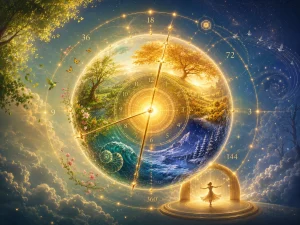
Spherical Clock
That is how the image of a spherical clock once appeared.
At first it was barely distinguishable: a circular protractor, a clock face, an axis, a center, an azimuth, a sphere.
We wanted to understand how all of it could be brought into alignment.
The clock model can be imagined approximately like this:
- A circle of 360 degrees
- A center
- An axis passing through the center
- An azimuth — a line connecting the zero point on the clock face with the center
- Movement that turns a motionless diagram into living time
If we take not an ordinary clock but a model of meaning, a day can be imagined not as 24 hours but as 18 hours.
Then one hour becomes equal to 20 degrees.
18 × 20° = 360°
The circle closes, and this is no longer an everyday clock but music.
A Year as a Circle — and That Is Beautiful
If a year is imagined in this rhythm, the number 9 fits especially beautifully.
9 months in a year.
Not calendar months, but months of meaning.
If each month has 40 days, then:
9 × 40 = 360
One day becomes one degree of the great circle.
Once again, what appears is not a rigid table but the breathing of a form.
The year becomes a circle.
A month becomes a measure of ripening.
A day, in turn, becomes one step along the circumference.
No one is arguing with the calendar.
This is simply another map.
A map does not replace the terrain.
It helps us see the pattern.
Three Seasons of Life
Moreover, in this model we want to keep not four seasons, but three:
- Spring
- Summer
- Winter
Autumn does not disappear from nature.
It certainly exists: leaves turn yellow, fruit ripens, the air grows colder, and the earth prepares for rest.
But in this model of meaning, autumn becomes not a separate realm, but a transition.
Perhaps it is summer turning toward winter.
Almost like an inclination toward winter, while spring remains eternal.
No one counts spring; people wait for it.
Summers are counted.
Winters are remembered.
Spring returns each time like the first breath.
That is why the old phrase sounds so deep: how many summers, how many winters.
Summers are counted.
Winters are remembered.
But Spring is eternal.
Stages of Life
Within this same rhythm, the stages of age begin to sound as well.
3 years — the first maternal circle.
A child is still within the mother’s field.
The child is not yet released from the breast, not only literally but inwardly as well.
The mother still holds warmth, nourishment, protection, and the primary world.
9 years — the first release.
Not 7, but precisely 9 sounds fuller: three times three. The child is already leaving the maternal circle, but has not yet become fully independent.
18 years — the beginning of independence.
Two circles of 9.
A person enters the world, but this is not yet maturity. It is a beginning.
36 years — ripening.
Two times 18. Here independence begins to understand the price of choice, consequences, measure, warmth, and responsibility.
And how beautifully it coincides: the body keeps living warmth at about 36 degrees.
36 years — the warmth of maturity.
36° — the warmth of the body.
Life Speaks Again Not Through a Number, but Through Rhythm
72 years — a great mature circle.
Two times 36. Here memory, the transmission of experience, and the inner summing up of a long path appear.
144 years — a full circle.
Two times 72.
This is no longer an ordinary calculation of age, but an ideal measure of a completed human cycle.
It is not a medical norm.
Nor is it a passport law.
And perhaps not a promise.
It is an image of a full circle.
There Is Play Here and the Right to Make a Mistake
It is important not to turn a living model into an iron cage.
This scheme contains play.
It certainly contains the right to make a mistake.
It also contains breath.
One person ripens earlier.
Another later.
Someone is already standing on their own feet at 18.
Someone only begins to hear themselves at 36.
And someone at 72 becomes lighter and more alive than they were at 40.
Life does not walk along a ruler. It keeps rhythm while leaving room for air.
This model is not meant for control, but for alignment.
It is also not meant to tell a person, “You are standing in the wrong place.” Instead, it gently asks: where is your center now?
Where did independence begin?
Has maturity become warm?
Is experience ready to become transmission?
Not Arguing with the Clock
Outer clocks show time.
Inner music and rhythm reveal the moment.
Clocks are needed because most people live by them.
They can say: it is now 20:20.
Yet the sky at that moment may be almost crimson.
And suddenly a person understands: time is not only numbers.
It is color.
Warmth.
A threshold.
A mood.
Ripening.
Alignment.
A person can be covered in watches and still not see them.
Not because they cannot feel time, but because a different music is sounding inside.
The Rhythm of Time. The Rhythm of Life
A spherical clock does not replace the ordinary calendar.
It simply shows that time can be felt not only through counting, but through breathing.
360 degrees of a circle.
18 hours in a day of meaning.
9 months in a great year.
40 weeks of pregnancy.
40 days as a measure of a month’s ripening.
3 seasons of life.
3, 9, 18, 36, 72, 144 — stages of unfolding.
All of this is offered not as dogma, but as a living attempt to hear alignment.
Time does not only pass; it breathes.
Life, in turn, does not only last; it ripens.
And if we listen closely, music begins to sound behind the calendar: the rhythm of time is the rhythm of life.
Final Part. The Dance Floor of Time
Once, we were already looking for harmony in space.
It began with a simple strip.
We divided it into three parts.
Then we divided the second third into three again.
The third part of the second third suddenly became a special place.
Not the main hall.
Not a corridor.
Not a service corner.
But a dance floor.
A place where form is not tightened completely, where play, air, a step to the side, a turn, and improvisation remain.
Then it became clear: harmony does not mean filling all space with usefulness.
Harmony means leaving Life room for movement.
Now the same principle has opened within time.
The Principle
A calendar gives a count.
A clock gives divisions.
A protractor gives degrees.
But living measure requires more than precision.
It needs play.
If a dance floor leaves room for movement in space, then play in time leaves room for destiny.
A person does not ripen along a ruler.
Life does not unfold on command.
Spring does not arrive because it was assigned a number in a calendar.
The body holds warmth not as a dry figure, but as a living balance.
That is why such beauty appears not in a rigid grid, but in alignment:
- 360 degrees of a circle
- 18 hours as a musical rhythm
- 9 months in a great year
- 40 days as a measure of ripening
- 40 weeks in which a child is carried
- 3 seasons
- 36 as body temperature
- 36 as the warmth of maturity
- 72 as great experience
- 144 as a full circle
Yet between these numbers, breath must remain.
The Right to Make a Mistake
In space, the golden ratio leaves room for a dance floor.
The third third of the second third is the golden ratio.
In time, living measure leaves play for destiny.
And this is perhaps the most important point.
Harmony exists where there is a center, rhythm, and room for a living step.
Form holds measure.
The center holds alignment.
And play leaves Life the right to dance.
That is why the rhythm of time is not a schedule.
It is music in which a person learns to hear not only the count, but the moment.
Not only the date, but ripening.
Not only age, but warmth.
And also the dance within the circle.
The rhythm of time becomes the rhythm of life when precision does not kill movement, but leaves Life room to dance.
Part 2. The Body Does Not Need to Be Dragged. It Needs to Be Heard
Control over the Body
Sometimes a person lives as though they were separate from the body.
The head thinks.
The eyes look.
The muscles try.
And the body becomes almost like a heavy object that has to be carried at all times.
Lift your leg.
Straighten your back.
Keep your balance.
Do not fall.
Place your foot correctly.
Control the movement.
The more a person tries, the heavier the body becomes.
From the outside, this may look like care and precision.
Inside, however, tension often lives there: a person does not trust the body, but operates it like an unfamiliar mechanism.
This creates a strange feeling: the body is present, yet the person does not fully live within it.
It is as though they are looking at the world through virtual-reality glasses and orienting themselves not by weight, feet, or the center of gravity, but by external lines.
By the picture before their eyes.
As long as vision is clear, the system holds.
But once the eyes close, a step becomes frightening.
Not because the body has forgotten how to walk.
Rather because the person stopped listening to it a long time ago.
The Feet as the First Return
Returning to the body does not begin with grand ideas.
It begins with the feet.
Feeling the ground beneath them is already an event.
Not merely knowing that the floor exists.
But feeling support.
The foot touches the earth, and the earth responds. The body’s weight is not hanging in emptiness. It finds a place where it can settle gently.
At that moment, a person returns from the head into presence.
They are no longer only thinking about themselves.
They are standing.
And this simple “I am standing” can sometimes matter more than many beautiful explanations.
Without support, any movement becomes anxious.
With support, the body begins to remember: it is not alone. The earth is beneath it.
The Center of Gravity
Then the center of gravity gradually reveals itself.
It is not merely a physical point. In living perception, it is the place where the body stops falling apart into separate commands.
If a person cannot feel the center, they begin to hold themselves together with muscles.
The back tightens.
The legs become wooden.
The shoulders rise.
The step grows cautious.
Movement loses its flavor.
The body seems to move, but it is being dragged.
When the center of gravity is found, everything changes.
Weight stops being an enemy.
It becomes a helper.
The body does not need to be constantly lifted, rearranged, and held. It is enough to hear where it is already ready to shift.
A step is born not from an order, but from a transfer of weight.
This is a very subtle difference.
A person can move through effort.
Or they can move through alignment.
The Body Uses Physics
If it is allowed to, the body does not like unnecessary work.
It does not seek to tense muscles for the sake of tension. It looks for physics.
Weight.
Support.
Inertia.
Leverage.
Turning.
Falling.
Balance.
Pause.
A good system always tries to let an action complete itself naturally.
Like an old plug pin in a switchboard: once the connection ended, it dropped out by itself, using its own weight.
It did not need to be pulled out by force every time. The structure was designed so that physics worked together with the action.
The body is the same.
It seeks not struggle, but the right design of movement.
Excess effort often reveals not strength, but misalignment.
When a person finds the right measure, movement happens more easily. Sometimes almost by itself.
The Relaxed Ease of a Master
That is why the highest mastery often looks like relaxed ease from the outside.
As though a person were moving lazily.
But this is not laziness.
Laziness avoids action.
The relaxed ease of mastery avoids unnecessary effort.
A beginner works with muscles.
A master works with weight, rhythm, angle, pause, and attention.
A good dancer does not jerk the body, but releases a wave.
An experienced driver does not fight the car, but softly enters its motion.
A craftsperson does not press the tool, but finds the right angle.
A wise person does not break a situation, but slightly changes its direction — and everything settles into place.
From the outside, it seems: “They are doing almost nothing.”
And that is exactly why it works.
There is no unnecessary noise.
A Clear Point of Orientation
When there is a center, there is measure, movement, and trust.
Attention leads, and the body carries it out.
This can be seen even in a simple line.
To draw a straight line by hand, two points are needed: point A and point B.
If a person begins controlling the hand, the line often trembles.
They watch the fingers, wrist, pressure, angle of the pencil, and every tiny correction.
The hand tightens, and the movement becomes uneven.
But if attention holds point B, the hand often draws a much straighter line.
The body does not need every detail explained.
It needs a clear point of orientation.
Attention sets the direction, and the body finds the path itself.
The same happens in movement.
If a person thinks, “Lift the leg, place the foot, keep balance,” the step becomes heavy.
But when there is direction, support, and trust in weight, the body assembles the step far more intelligently.
The hand moves more smoothly when it is not dragged, but guided by attention.
The body moves more easily when excessive control does not interfere with it.
Between Control and Drifting
There is an important subtlety here.
Two extremes exist.
The first is rigid control.
Then a person tries to manage every muscle, every step, and every gesture.
Movement loses its aliveness, and the body becomes heavy.
The second extreme is drifting.
A person seems to release movement, but along with it may also release attention, measure, and responsibility.
The living path lies between them.
One needs to be a navigator.
A navigator does not carry the ship on their back. They do not command every wave or cancel the wind.
But they hold the course.
They see the direction, feel the movement, watch the signs, and remain ready to provide support if needed.
The same is true with the body.
There is no need to command every muscle.
But it is also unwise to abandon the body without attention.
One needs to stay beside the movement.
Feel the feet.
Hear the center of gravity.
Hold the direction.
Enjoy the beauty of motion.
And gently help if movement begins to lose its measure.
A navigator does not prevent movement from being alive.
They hold the course and leave the body the right to move beautifully.
School of Waltz
That is why this theme belongs to the School of Waltz.
A waltz is not merely a dance.
It is a way to understand that movement is born through alignment.
The partner does not drag the woman.
The woman does not hang on the partner.
The floor is not an enemy.
Weight is not an obstacle.
A turn is not a struggle.
Music is not a command.
In a good waltz, everything joins together:
Support
Center
Weight
Rhythm
Direction
Trust
Play
Backup
Then movement becomes beautiful not because it was perfectly controlled.
It becomes beautiful because it was allowed to remain alive.
Realization
The body does not need to be dragged. It needs to be heard.
It knows how to stand and hold weight.
It knows how to shift the center.
But a person needs to return to alliance with it. Not live only through the eyes, but become a navigator.
Look ahead.
Feel the support.
Trust the body.
And stay beside it.
Conclusion
The path back to the body begins with the feet. Then a person finds the center of gravity.
Then they hear inner support.
And after that, they learn not to drag the body, but to walk together with it.
The body is not a burden a person carries.
The body is a living ally.
When trust is returned to it, movement stops being heavy work.
It becomes a waltz.
Control constricts.
Drifting loses measure.
The navigator holds the course.
And a body that is trusted begins to move beautifully.
Udanna Light and Awareness, close to Udanna.