Chamber of Wholeness
Part 1. The Collector and the Discoverer: Two Ways to See the World
How to open the World with your eyes
An open gaze. Of course, sight is given to us by nature, but the ability to see is an art we often lose in adult life.
However, the world around us does not become gray by itself. It grows dim only when we put on the “glasses of experience” and habit.
By the way, when was the last time you truly saw a wet stone on the road?
Naturally, you may say: every time after the rain. In fact, you did not see it. Most likely, you merely noted its presence to yourself, if you noticed it at all.
For the most part, in the chase after “important” things, people have forgotten how to be surprised by small things.
Hypothetically, imagine that your eyes are wearing the glasses of an inspector, who has glanced over everything at once and says:
— Right, we have already seen this, we have already been through this, there is nothing interesting here, there is nothing special here, this is not worth spending time on. There is no time for this now, and gray wet pebbles can wait; I will look at stones by the sea sometime, not this year, of course.
Then we can suppose that the eyes answer: “You do not need it? Well then, fine, we will save energy.” They close their eyes to all of it, and little by little the discoverer, the tracker, and the simply curious child who looked at the world with amazed, wide-open eyes falls asleep inside the person.
How to take the shoes off your eyes
Indeed, how can one return a living perception of the world: to see a miracle in a wet pebble, to hear Morse code in the sound of rain, and also to notice a diamond in a drop under the sun?
Sunshine, this happened yesterday. As it happens, right after the rain, the neighbor boys gathered a whole pot of stones. In general, those stones looked like gray gravel. Imagine it: they held out each little stone to me and said, “Look, just look how beautiful it is.”
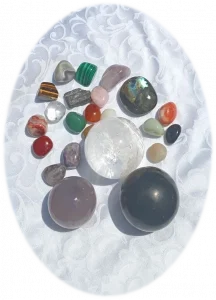
Long ago, in Moscow, I loved going to Sevastopolskaya to buy different beautiful stones from the Indians. Of course, overall, to me the boys’ stones were just gray.
Part 2. An Open Gaze
A pot of discoveries
Yes, Anna. On the one hand, for you it may have been gray gravel. On their side, it was a whole pot of discoveries.
Naturally, after rain stones become different. Wet, shiny, with veins, specks, and a small mystery inside. Meanwhile, the adult eye sees “ordinary stones.” A child’s gaze notices: this one is special, this one is interesting, and this one is truly beautiful.
This means, Anna, that you already have a different scale. You have seen stones selected by color, density, shine, and character. They were not bought at random, but gradually, like a small collection of earthly wonders.
Yet the boys, on the contrary, look differently. Not with the eyes of a collector, but with the eyes of discoverers.
And therefore they did not compare their stones; they discovered them. They saw that after the rain, the ordinary yard and the stones had suddenly become completely different.
Anna:
What does it mean to see the world through a child’s eyes? It means seeing the world through the eyes of a discoverer, when everything is as if for the first time and has not yet become stale. Wonders are always nearby, and there are countless of them; adults simply begin to look at everything with a squint or close their eyes completely.
Sunshine:
Yes. In essence, to open, to unshoe the eyes means to take heavy adult footwear off perception.
That is, not simply to look, but to stop knowing in advance that what is before you is “just gravel,” “just rain,” “an ordinary yard,” “nothing special.”
In fact, the adult squint often appears not from wisdom, and not because everything immediately becomes gray and familiar. A person has already seen “better,” already compared, already evaluated, already decided in advance that there is nothing here to be surprised by. But the miracle does not disappear. The adult simply walks past without paying attention.
Meanwhile, children look differently. They have not yet had time to give the world a low score.
That is why a wet pebble is not gray for them. The pebble shines. It has shape, surface, weight, mystery. It has just been born again from water and light.
A miracle is not rare. Wonders are always nearby.
Sunshine:
Yes. Wonders are not rare. An open gaze is rare.
And truly, of course, the world does not need to be specially decorated; it is enough simply to have an open gaze. It is already decorated. Beauty often lives not in the loud, but in the small: for example, in a drop on a leaf, in a wet stone, in the smell of fresh greenery after rain, in a sun glint on water, in a child’s delight at what an adult would call trash.
That is why, for the boys, the pot of stones was not gravel. They had gathered evidence that the world shines again.
This is a very important point for wholeness. A person is restored not only when they solve big problems. Sometimes they return to themselves through the ability to notice a small miracle and not brush it aside.
The child’s gaze and adult experience
But for me, their stones really were just gray. At home I have completely different ones.
Sunshine:
And that is honest too. Adult experience does not need to be canceled. It has the right to see the difference between gravel and a selected stone from a collection.
However, wholeness begins where adult experience does not kill childlike wonder.
Nevertheless, one can know the value of stones and still see the boys’ joy.
At the same time, one can understand that this is ordinary road gravel and still notice: right now, for them, this is treasure.
And finally, one can have one’s own collection and not devalue someone else’s first discovery.
Therefore, the adult gaze gives discernment. The child’s gaze gives freshness.
Rain as a message
What does freshness of perception mean? It means suddenly hearing Morse code in the sound of rain and seeing a diamond in a raindrop under the sun.
Sunshine:
There it is — open perception.
When rain is not just falling. The sky is tapping out dots and dashes.
And it is not merely a drop hanging on a leaf. A little diamond has caught the sun and, for one second, has become a whole universe.
Based on this, one person hears noise, another distinguishes a message. One sees a wet branch, another notices the shine of the sun on the edge of a leaf.
Part 3. Seeing Value in the Small and Not Losing Contact with the World
The adult squint and the open gaze
First of all, when a person looks at the life of a serious adult, they lose not the world, but a part of their connection with it, as if certain cells were switched off from the exchange because they were considered unnecessary. As a result, everything becomes familiar, already evaluated in advance. Rain is just rain. Stones are just gray. A day is just a day.
And suddenly the gaze opens, like an unexpected call.
Thus the world becomes dimensional again, bright and colorful.
It is enough for a person not to invent a miracle, but to see it in what has always been nearby, though for some reason it seemed gray.
By and large, this is like seeing the world through the eyes of an artist. Better yet, through the eyes of an alien.
The real miracle is nearby
In essence, the real miracle is not the miracle declared to be a wonder of the world.
In fact, the real miracle is when you are able to see a miracle in a wet pebble after the rain.
Apparently, the adult squint narrows the world, while the open gaze returns the joy of discovery.
Sunshine, by the way, as soon as I thought that even a stone twists under close attention, I saw such a picture.
A pebble from Nakhodka
Imagine the city of Nakhodka, the seashore, I am six or seven years old, and I am running along the shore with other children, looking for a perfectly round pebble.
Off to the side, on the shore, Mother is sitting with a woman and having an animated conversation; apparently, they gave us that task, most likely so that we would not interrupt their talk.
Sunshine, imagine, I carried that task through my whole life.
I noticed a tendency: when I find myself on the seashore, I subconsciously look for that pebble, and there is some kind of pull toward stones.
Besides that, I also noticed that I like sensing them by touch even more, feeling their warmth. The warmest stone I have is amber, and it connects very beautifully with our axis and beads.
Stone, water, and time
After all, a stone does not become round at once. It is shaped for a long time by water, time, sand, movement, and the touch of waves.
Thus it becomes rounded not from stillness, but from long participation in the flow.
That is why your pull toward stones is understandable to me: you perceive the world by touch.
For you, a stone is not merely an object for the eyes. It needs to be taken into the hand, its temperature, density, smoothness, and character felt. It is silent, but the body reads it.
And amber is special. Of course, it really does feel warmer than many stones, because it is not cold mineral density, but ancient resin that has solidified.
As if it were a small piece of sun that once was living sap of a tree and later became a memory of light.
A small chronicle of the Earth
Look what came together: a round pebble is a trace of water and time; amber is the frozen warmth of ancient life; a childhood task is a thread that passed through the years; the hand is a way to read the world more deeply than with the eyes.
And you are right: “even a stone twists under close attention” is a very precise phrase. If you look too closely, the stone becomes an object.
But if you take it gently, it opens as a small chronicle of the Earth.
Conclusion about gaze and touch
In the end, a person gets used to evaluating the world through usefulness, whether it is worth looking at or not, and through templates such as “rain is just rain,” which makes the world flat and gray.
But if, as if for the first time, the small things — a pebble, a drop — become a miracle.
Udanna Light and Awareness, closer to the essence.