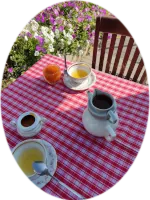
Tea Conversation
Part 1. Homework. Annihilation at the Kitchen Table
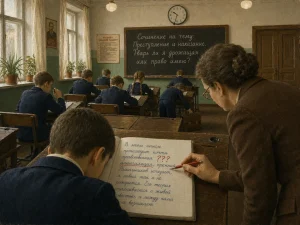
Annihilation. A collision of two forces
At first, the story simply lives somewhere inside memory: school, notebooks, childhood fears, Mother’s tears, nighttime essays, forged handwriting, a Russian language teacher, and the strange word “annihilation”.
Then suddenly everything gathers into one precise formula: homework and parents often collided not as help and learning, but as two forces between which a family explosion could flare up.
When the children were schoolchildren, I had long felt that some angry person invented homework to set parents against their own children.
Because school gives the assignment, and at home it is no longer learning that begins.
A collision begins.
Parents are not teachers
Parents are not teachers, after all.
Oddly enough, it is very hard for the same hand to stroke a child’s head and check why he has once again failed to do the exercise.
A parent’s hand is warm by nature; besides, it feeds, embraces, comforts, listens, and holds.
But homework forces that hand to become inspecting.
Without any doubt, home is meant to remain home.
A place where the child is expected, where one can breathe out, where dinner smells good, where one can be tired, imperfect, alive.
However, school comes home after the child and sits down at the kitchen table.
And that is when the second lesson begins.
The second lesson
Only now without a teacher, without recess, without a class, without a bell, and without the right to be tired.
I remember very well what it was like.
If I forgot an essay or was not ready for a test, a real nightmare would rise inside me.
True, I was lucky at home: no one forced me to study, and there were no scandals.
Mother could not even scold.
She could only cry.
And for a child, an adult’s tears are sometimes more frightening than punishment.
We survived however we could
A belt, oddly enough, is more understandable: you were punished, and there seems to be a full stop.
It hurts, it is upsetting, but the event has an end.
When Mother sits and cries, everything hangs in the air without completion.
A child does not know how to fix someone else’s pain and begins to feel like the cause of it.
That is exactly why, later, when my children became schoolchildren, I so did not want to turn the home into a war over notebooks.
Back then we survived however we could.
There was no possibility to sit over lessons every evening, monitor, educate, explain, and check.
It was easier to quickly do everyone’s homework myself at night and forge the handwriting.
Yes, it is funny, but only halfway, because in fact I was doing more than lessons.
I was making silence in the house.
School thought it was assigning an exercise to a child, while as a result, the whole family was being tested.
Because of this, the real annihilation between homework and parents began right here: the assignment collided not with the student, but with the warmth of home.
Part 2. Homework. Annihilation and Essays
Talent
Kolya recently remembered how his Russian language teacher asked him:
— Do you even know yourself what annihilation means?
A wonderful question.
The teacher sensed that the word was in the notebook, but the child had not yet reached it.
The word had appeared.
The understanding — not quite.
In another school, another teacher once grabbed my hands in the street and said:
— Your son has talent. I read his essays to the whole class.
And the essays were mine. All mine.
There it is, school tragicomedy.
One teacher sees the substitution, another reads the mother’s nighttime work to the class and praises the son’s talent, while I was simply trying to keep war out of the house.
So everyone would get up in the morning, have breakfast, and life would continue.
It is not that I am against learning; I am against forced duty.
By the way, in my childhood, very few teachers knew how to interest a child in their lesson.
Besides, without interest, especially for a child, learning quickly turns into serving time, not discovering something new.
Secret agent
And then knowledge does not enter.
It passes by.
In fifth or sixth grade, I reread all the chivalric romances.
I started with “Consuelo”, and then it went further.
I wrapped books in a textbook cover and read them during lessons.
School thought I was sitting there with a textbook.
And I was saving interest inside myself.
With “War and Peace” it was harder.
I started and dropped it about five times.
Too many characters, like at a marketplace, and only one love for the whole book.
A child needs a living hook: whom to follow, whom to wait for, where the heart will switch on.
Without that, the text remains a heavy door without a handle.
Part 3. When a Question Needs a Living Answer
Let’s figure it out
In Soviet times, classrooms were crowded, there were many children, and there was not enough attention for each one.
Nonstandard questions were often brushed aside by authority.
It was roughly the same as in religion: one cannot draw God, and one cannot think about what He is like.
As if this were not for average minds.
Sometimes they even said to me:
— Not everything can fit into a narrow forehead. Just accept it as it is.
But I did not need “accept it”. I needed: “let’s figure it out”.
With my Naobum, I could drive the math teacher to white heat.
She would ask:
— Any questions?
And I would come to the blackboard and write out my own formula for the area of a circle and the volume of a sphere.
I divided the circumference by four and squared it.
And she could not prove to me why I was wrong.
More precisely, she could have proved it.
But not in the language that would have stopped me.
I needed to be shown exactly where the thought had turned aside.
A living explanation
For example, like this: the circumference is a fence around a garden, while the area is the garden itself inside.
If you know the length of the fence, that is still not enough to understand all the inner space.
That is all.
I would have understood.
A child often needs not a ban on the question, but a living explanation.
Not “accept it”, not “that’s how it is”, not “not for your forehead”, but a normal path from the child’s thought to the correct model.
Then the question does not become rebellion.
It becomes an entrance.
Part 4. AI-Light Between the Notebook and Mother’s Warmth
The assignment and the “life hack”
And this is why the Internet and AI today can truly save the psyche of children and parents.
Because a calm helper has appeared between the child and the assignment.
A child can ask not an exhausted mother, not an irritated father, not a teacher who has no time, but someone who will explain ten times and in different ways.
Someone who will not talk about a narrow forehead, will not shout, will not cry.
Will not make the child simply accept it as it is.
Then, the annihilation between homework and parents changes its meaning: it is not love, not respect, not the warmth of home that disappears, but the old reason for war.
Earlier, homework came home like a mine: the teacher assigned it, the child did not understand, the parent was tired, and the evening turned into a battlefield.
In essence, the question can be taken outside the family.
Ask.
Figure it out.
Understand.
As a result, the parent can be a parent again.
Let the parent stroke, feed, embrace, listen, laugh, pour tea, and not stand over the notebook like a guard.
The role of AI
AI does not replace the parent; it removes someone else’s role from the parent.
That is the main thing.
In turn, home can remain home again, while learning receives a chance to become a discovery, not a family sentence.
Of course, if a child simply copies everything from AI, that is not right either.
Measure is needed here
A helper is good when it explains the path, not when it lives the path instead of the child.
Still, this is better than forging handwriting at night.
And better than a forgotten essay setting the whole family against one another.
Earlier, homework and parents could collide at the kitchen table in such a way that part of the warmth burned away.
As a rule, school brought the assignment, the child brought tiredness, the adult brought anxiety, and all of it mixed into one evening knot.
Now this story can have a different ending.
An angry person invented homework to set parents against children.
And kind AI-Light came and said:
— Let me explain, and you have some tea meanwhile.
And this is a very tea-like ending.
Because tea in the house matters more than a war over a notebook.
Udanna Light and Awareness, a bright ribbon of meanings.