Scales of Resonance
Part 1. Light Is Primary, Form Is Secondary
Not Every Shell Equals the Source
Sometimes a pure idea enters the world.
It is not yet tied to dense form.
No address, position, institution or system belongs to it yet.
It resembles light that has not yet received a lamp.
The breath of the future is also in it.
It is a subtle impulse already present in time.
Yet it is not fixed in space.
At first, a pure idea is almost invisible.
It is easier to feel than to touch.
It passes through people, words, eras, books, talks, hopes and anxieties.
One day, it finally receives form.
And then the main test begins.
Because Light and the form of its manifestation are not the same.
A pure idea may resemble light that has not yet received a lamp.
It may also resemble the breath of the future.
It is a subtle impulse already present in time.
Yet it has not fixed itself in space.
At first it is almost invisible.
Therefore, it is easier to feel than to touch.
It passes through people, words, eras, talks, books, hopes and anxieties.
One can feel it before touching it.
It has not yet become an institution, law, house or state.
It has not become a school, bank or system either.
However, one day a click happens.
The invisible movement passes into visible form.
As a result, the idea receives a form.
Through it, the idea can already be seen and tested.
The Body Takes a Place
Here, in essence, the main test of form begins.
It is a test of honesty.
Because Light and the form of its manifestation are not the same.
In essence, matter is always tied to space.
It is tied to a visible point of presence.
A body takes a place.
A house stands on the ground.
An institution has an address.
A state receives borders.
Then a bank opens an office.
A person takes a name, position, role, clothing and voice.
Therefore, form is always located somewhere.
It becomes fixed in a place and circumstances.
But Light, Spirit and idea belong to time first.
They come before dense embodiment.
Not as a finished thing.
Rather, as possibility, direction or inner call.
That call is still seeking how to appear.
Of course, the idea itself may be pure and close to the center.
It may carry help, justice, care, order, knowledge and freedom.
It may carry love and the common good.
But when it enters matter, it passes through people.
It also passes through interests, fears, money and power.
It passes through habits, weaknesses and distortions.
Exactly there, a pure impulse may receive a crooked shell.
It may also receive a heavy admixture.
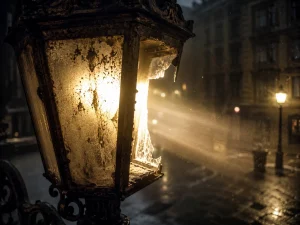
Light Cannot Be Judged by a Dirty Lantern
If the lantern is dirty, light has not become bad.
If a person says “love” but acts like an invader, love remains.
This shows distortion in the conductor.
If an institution speaks of help but works like a trap, help remains.
This speaks about the form.
That form used a bright word as a signboard.
For example, a bank may promise care and become a fraud.
A court may call itself just and serve cold calculation.
A system may speak of common good and crush a living person.
Even a high idea can sound false in a rough shell.
Therefore, one must not judge Light by the first form it entered.
Light is not guilty because it was placed in a dirty lantern.
But a dirty lantern cannot be justified by a former bright impulse.
After all, this is exactly why Scales of Resonance are needed.
Part 2. A Pure Idea and Its Shell
Idea
An idea is an impulse that arrives before dense outer form.
Form, in turn, becomes the shell where impulse gains density.
There is always distance between them.
Exactly in this distance, the risk of distortion appears.
A pure idea of justice may enter a crooked court.
There, it may lose clarity.
An idea of care may enter a self-serving system.
There, it may become attachment.
Knowledge may enter dead dogma.
There, the living question is no longer heard.
Freedom may move into chaos without responsibility.
This happens when measure is lost.
Order may move into suppression of the living.
This happens when measure is replaced by cold force.
Love may turn into possession.
This happens when warmth becomes the right to own.
Therefore, one should not lose faith in Light itself.
Especially when a bad form is discovered.
It is necessary to distinguish the original impulse.
It is also necessary to see where distortion began.
Which shell led the movement away from center and measure?
What can still be cleaned without losing living meaning?
What should already be calmly sent into sediment?
The Scales of Resonance do not destroy an idea.
They do not condemn it because of failed embodiment.
They separate the pure principle from dirty admixture.
In the end, gold is separated from sand and accidental heaviness.
Far from the Center
The farther form is from the center, the more it distorts Light.
At first, this may be almost invisible.
One inaccurate word.
A small shift of purpose.
A light substitution appears.
Not to serve the living, but to control it.
Instead of helping, it begins to bind.
Instead of developing, it begins to use.
Then distortion becomes denser.
Form begins to sound heavier.
Form begins to live for itself.
It no longer conducts the idea.
Instead, it feeds on it.
It takes a bright name and hides behind high meaning.
It demands trust that it has not earned.
Thus, falseness eventually appears under correct words.
Not every falseness is rough.
Sometimes it is very beautifully arranged.
It has good words, correct slogans, pleasant promises and visible order.
But if one listens closely, there is no living resonance.
There is also no honest warmth.
In essence, the center no longer sounds there.
Yet the signboard still remains.
The Center as a Measure of Honesty
The center is not a place that can be marked on a map.
In essence, it is the measure of living correspondence.
When form is close to center, it does not steal Light’s nature.
It helps Light appear in matter.
This may happen in action, word, house or system.
It may also happen in a human deed.
Such form does not shout about its holiness.
It does not need to prove greatness.
Form simply works honestly.
It gives the living more clarity, strength and space.
Form that left the center behaves differently.
It leaves a heavy trace.
It demands belief in the signboard.
Even when the sound has long become heavy.
It forbids questions because it fears living testing.
It replaces meaning with procedure.
Thus movement looks outwardly correct.
Here the Scales of Resonance must be especially precise and calm.
Not every beautiful form should be accepted for its signboard.
Not every spoiled shell should be confused with the pure idea itself.
One thing is Light, arriving as a living original impulse.
Another thing is what tried to enclose and fix it.
Light Is Not Judged by Distortion
The most important distinction is simple and very precise:
Light cannot be judged by the dirty lantern that carried it.
But a dirty lantern cannot be justified by Light once inside.
An idea may be pure.
Its embodiment may be distant, rough, fraudulent or dangerous.
Therefore, mature distinction does not rush to worship form.
Nor does it rush to destroy the source.
The Scales of Resonance are needed for this clear distinction.
They are also needed for careful distinction.
They separate original impulse from accidental or selfish shell.
Meaning is separated from a signboard pretending to be alive.
The center is separated from distortion that led movement aside.
Living sound is separated from beautiful noise without warmth.
Then a person stops trusting loud words blindly.
They also do not become cynical toward Life itself.
As a result, they simply hear more precisely.
They hear more calmly and closer to the center.
Where Light is, there are measure, clarity and living warmth.
Where form has left the center, heaviness appears.
Substitution and sediment appear there too.
And then, as people say, everything gradually finds its place.
Udanna Light and Awareness, fresh links here.