
Architecture of Ether
Part 1. Theater. From Flask to Theater
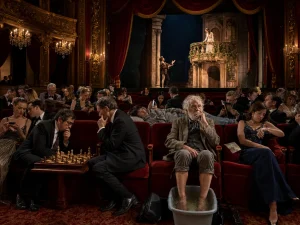
The Environment of a Role
The Journey of Meanings begins where a person sees not only text.
They enter a living space of role, choice and response.
Therefore, the site becomes not a shelf with pages, but a theater of entry.
If a phenomenon needs an environment, then a person needs a space of role.
A table gives a plane, a flask gives volume, and a theater gives a living structure.
In it, movement receives a place, a direction, a viewer and a stage.
In a flask, one can see how a process arises, while in a theater something else becomes visible. There, the process begins to be lived through.
Life is a theater, and everyone has a ticket.
Everyone can take their place, yet not everyone remembers why they came here.
This is not simply a beautiful metaphor. A theater has an arrangement: stage, hall, backstage, passages, doors, light and music.
In addition, there is silence before the action begins.
There are leading roles and background roles, as well as viewers, prompters, musicians and masters of light.
Besides, there are those who are almost unnoticed. Yet it is precisely they who hold the order of the space.
At first glance, the main thing happens on stage.
Faces are visible there and words are heard there. The familiar plot unfolds there.
Nevertheless, the theater is held not only by the stage.
If the light disappears, the viewer will not see the action; if the music falls silent, the rhythm will change.
Still, if the backstage stops, beauty will quickly begin to fall apart. So it is in Life.
One person enters the center of events, another holds the background, a third opens the door.
Someone prompts a forgotten word, and someone meets the flow at the entrance.
Therefore, no role is accidental.
Part 2. Theater. Role, Place and Access
Structure Without a Cage
Freedom in such a theater does not mean chaos. Each role has its own rules.
Obviously, there is its own access and measure of responsibility.
In other words, the viewer is not obliged to play the leading role, and the actor cannot forget about others.
The prompter helps, but does not live the role instead of another.
The doorman opens the entrance, but he does not decide where a person will go next.
And it is exactly here that the Architecture of Ether appears.
The structure exists, but it is not dead. It holds the space.
Therefore, free play does not turn into noise.
Also, it does not become a struggle for someone else’s place.
A person can choose a role, change it as they mature, but each change requires alignment.
It is not enough to want to step onto the stage; the role needs to coincide with time.
In addition, a place and an inner state are needed.
Therefore, the true place is not always the most noticeable one. It is where a person sounds honestly. Sometimes this is the center of the stage. At times, it is the quiet backstage.
And sometimes a person needs to walk in circles around the hall. This is how they see the arrangement of the field.
While others are occupied with seats, they study the theater. This is also a role.
Part 3. Hall, Stage and Forgotten Meaning
When Place Becomes More Important Than Meaning
A long-known play may be running on stage.
The plot may be familiar, and the words may sound recognizable. The ending seems almost predictable.
However, true Life is revealed not only on the stage; it also manifests in the hall.
A person comes with a ticket, but instead of asking “why am I here?” looks for a more comfortable seat.
One settles in so that no one disturbs them, another stretches out across the chairs, and a third is occupied not with meaning, but with comfort.
So the hall gradually expands.
The stage remains, but attention moves into everyday comfort; in addition, status appears, along with division of places.
People are in one theater, nevertheless they look at meaning less and less.
When people stop seeing the stage of meaning, the hall grows by itself.
There is an important warning in this: life gives a ticket not only for a seat, but also for participation in the common action.
However, if a person forgets the purpose of entry, the theater changes and becomes a space of seating.
Part 4. The Right to Make a Mistake
The Play of a Living System
If Life is a theater of play, a mistake becomes part of participation.
Without this right, a person stops playing. They fear every step and every word.
Instead of movement, freezing appears.
But a living system works differently. It leaves play in the mechanism.
This is a small space for trial movement.
There one can shift, make a mistake and see the consequences.
Sometimes a mistake also becomes information.
A person may choose the wrong place.
They may come out at the wrong moment.
Or they may take someone else’s role for their own.
Still, they may remain a viewer for too long.
However, when there is reserve, the system does not collapse.
The mistake shows where a new adjustment is needed.
At the same time, the right to make a mistake has a boundary.
It does not allow breaking the theater.
Freedom of play does not cancel the law.
If Life is a theater of play, a mistake becomes part of participation.
Without this right, a person stops playing. They fear every step and every word.
Instead of movement, freezing appears.
But a living system works differently. It leaves play in the mechanism.
This is a small space for trial movement.
There one can shift, make a mistake and see the consequences.
Sometimes a mistake also becomes information.
A person may choose the wrong place.
They may come out at the wrong moment.
Or they may take someone else’s role for their own.
Still, they may remain a viewer for too long.
However, when there is reserve, the system does not collapse.
The mistake shows where a new adjustment is needed.
At the same time, the right to make a mistake has a boundary.
It does not allow breaking the theater.
Freedom of play does not cancel the law.
When a person violates measure, they meet measure.
Pressure sown into the field returns as tension.
Choosing lies means living among distorted reflections.
The law does not take revenge. It returns to a person the harvest of their sowing.
Therefore, the right to make a mistake and responsibility do not argue. Responsibility helps one see the result of a choice.
Together they create not fear of Life, but maturity of participation.
In a living theater, no one knows the whole text at once.
Everyone recognizes their role through movement.
In addition, response and alignment with the field help.
Part 5. The Law of Free Play
Truth as the Center of Alignment
Free play does not cancel structure; it becomes possible precisely thanks to structure.
A theater is not held by one actor, and life is not held by one role. The common field is not held by one personal truth.
Each brings their own experience, occupies their own position, and each also has an angle of view and a measure of participation.
But if a personal truth demands the center, distortion appears.
Then a role becomes seizure, freedom turns into noise, and place becomes a claim.
Truth is the center of common alignment and manifests differently. Nevertheless, personal truths of different times find measure.
Law is truth that has taken a stable form.
Such a law can be understood more deeply and expressed more precisely. It can be applied more gently, but it cannot be replaced by benefit or fear.
Therefore, the main question is not the visibility of the role. The main question sounds differently. What does a person bring into the space through their role?
If they bring clarity, there is more clarity. The space contracts if they bring pressure. If they sow care, connection appears; if they sow emptiness, one day they remain among emptiness.
What you sow is what you reap.
This is not a threat and not a punishment; it is the law of correspondence. In the great theater of Life, every action sounds farther than the person.
Each word enters the space, and each choice becomes part of the common acoustics.
Part 6. Journey of Meanings
From Answer to Path
The Journey of Meanings begins not with testing a person, but with an invitation to a path.
A person stops simply occupying a place. They remember why they entered the theater.
Not every path leads to the stage. Not every entrance requires loud action. The answer does not have to be the only correct one.
Sometimes it is more important not to guess, but to see where the chosen door leads.
One person will enter through a simple image, another through connection, a third through a difficult question.
There, responsibility is already needed.
All these entrances can be correct if they lead to an honest understanding of oneself. This is the Journey of Meanings, which does not divide answers into right and wrong, but helps reveal a person’s place.
In addition, it shows their choice, response and next path.
A site of the old type gives pages, AI gives answers, and the Journey of Meanings gives a road.
The Journey of Meanings offers three steps. First comes a simple image. Then a deeper connection. In the end, a difficult question opens a new level where the answer always leads further.
However, the path changes depending on the chosen door. Therefore, the game does not punish with a mistake. It reveals a personal route.
Try to find yourself in the Journey of Meanings. Perhaps along the way your role will open, and together with it, your honest place in the theater of Life will appear.
Life Is a Theater of Free Play
Everyone has a ticket. Everyone can take their place. However, not everyone remembers why they came here.
A role can be chosen, can be changed, but every role requires access and measure.
The right to make a mistake is given together with the ticket into Life.
To make a mistake does not mean to lose one’s place; it means to clarify the role and direction. Nevertheless, freedom does not cancel the law.
The Law of Life does not take revenge and does not bargain; it returns to a person the harvest of their sowing.
And that means the real game does not begin in a comfortable chair. It begins where a person turns toward meaning.
The Journey of Meanings becomes this road. It leads from answer to path, and perhaps it is exactly there that the living game of Udanna begins.
Udanna Light and Awareness, quiet discoveries nearby.