
Architecture of Ether
Part 1. In Anticipation of Fire: Threshold, Trace, and Invisible Framework
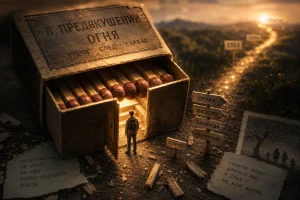
Expectation becomes a framework
In anticipation of fire, a person stands not inside the event, but before it.
The event, however, has not happened yet. The fact, in essence, has not arrived yet.
Yet inside, the form of future experience is already gathering.
At first glance, anticipation often seems like a light state.
As if a person is simply waiting.
In reality, expectation can become a framework.
Sometimes it even becomes a foundation.
An event may last only a moment, yet its trace can remain for many years.
Why does this happen?
Because the threshold works deeper than the fact. At the threshold, a person still does not know the result.
He feels possibility. He holds fear, interest, hope, and inner tension.
Right there, the invisible architecture of a future attitude begins to form.
Anticipation as a hidden foundation
Anticipation does not always look like joy.
At times it can be anxious or funny, and sometimes almost unbearable.
A person stands before a closed door. Something is already hidden behind it, but he has not entered yet.
That is why imagination begins to work much more strongly than any reality.
While the fact remains silent, the image grows.
In essence, a person completes it with scents, expectation, fears, and hopes.
This is how the inner house of an event is born.
Then the event enters not into emptiness.
It enters a prepared space.
There is already a place, light, tension, and direction there.
So the first day may pass quickly.
But the road toward it stays in memory for a long time.
Childhood New Year, for example, is often held not by the night of the holiday.
It was held by tangerines, apples, a box of ornaments, and the rustle of paper.
The holiday had not come yet, but it was already living in the room.
The threshold in anticipation of fire
The threshold is not a decoration of the event. It, in turn, creates the depth of transition.
Without a threshold, everything becomes flat.
When everything is available at once, anticipation weakens.
For example, one can try sooner, receive faster, replace more easily.
There are more things, but less inner fire.
Earlier, many events had a real entrance.
Before a wedding, a dowry was prepared.
People sewed, embroidered, gathered a home. They waited for the harvest, the proper time, consent, and a shared day.
It was not just preparation.
In essence, it was the slow construction of a future bond.
Stitch by stitch, a person entered a new life.
Fabric, bread, a chest, a yard, and family conversations all became part of the waiting.
Of course, the past is not worth idealizing.
There was much heaviness there. Still, the threshold itself was stronger.
The transition was real. Fear and curiosity lived there together. Their union left a deep trace.
How expectation holds an attitude
An attitude rarely begins with a fact.
Often it begins earlier.
With a glance, expectation, an inner turn, the first secret hope.
A person has not received anything yet.
But inside, in essence, soil has already appeared.
Later, a bond grows in that soil.
Sometimes it becomes stronger.
Sometimes it dries out. Yet the first trace has already been left.
Anticipation can be fertile soil for relationships.
It gives roots time.
A feeling does not fall at once onto bare ground.
It settles into a prepared layer.
This happens not only in love.
It happens in friendship, in travel, in creativity.
Even a new site page first lives as a premonition.
First of all, a spark arrives. Then air gathers around it.
As a result, a form appears. Only after that does fire become visible.
It is in anticipation of fire that a future bond receives its first framework.
Part 2. Matches as an image of the threshold
The potential of a match
A special match turned out to be an exact image of this theme.
For now, it is not burning yet.
There is no warmth yet. In truth, there is no light yet. But the possibility has already gathered.
The match is small, yet it knows its potential.
It contains the silence before a flash.
It also contains the tension of form before transformation.
The match seemed almost twisted in anticipation of fire. That feature was what drew attention.
Its unusual configuration became a living sign.
A matchbox, by the way, also speaks about a threshold.
It is tight and dark there. But inside lies a small fire in the future tense.
The old joke about revolution catches for this reason.
The mood of people then was like a matchbox.
Dark, cramped, but everyone has a spark. Rough, yes, but the image is precise.
The antechamber is not always spacious. Sometimes it compresses, yet that very compression gathers force.
A seed is also tight, and a bud is tightly closed.
A chick is also cramped inside the shell. Each of these images contains a transition.
Relationships in anticipation of fire
The state of anticipation of fire, in essence, can become deeper than the event itself.
Because expectation includes the whole person.
He does not simply receive a fact. In essence, he lives in advance through its approach.
In any case, children know this better than adults.
For example, mother is coming back from the store with bags.
She has barely appeared, and the children are already on the windowsill.
They jump, look, and cling to the glass.
One child may even lick the window out of impatience.
It is funny, but very exact. He has not received anything yet. Yet the holiday is already inside.
Mother is carrying not only groceries.
Mother herself is in anticipation too.
In just a little while, she will see fire and sparkle in their eyes.
So anticipation becomes a shared bond. Some are waiting. Another is carrying. The meeting begins even before the door opens.
Remove this expectation, and perhaps only purchases remain. But the small holiday of return disappears.
The army as a field of thresholds
There is, by the way, one more observation.
A person served his term for a short time.
Later he remembers and chews over stories from there all his life.
At the same time, he was passing through his thresholds there.
Many things happened for the first time.
The first order, the first duty shift, the first fear, and the first failure.
Each threshold, as a result, cut memory more deeply than an ordinary day.
That is why army stories are later savored for years.
Even anxious episodes become a special material of memory.
More precisely, a person remembers not only the fact.
He remembers the entrance into the unknown. He remembers himself before the transition.
It was unclear there. Sometimes frightening. Yet that is exactly why the trace became bright.
Architecture of Ether sees here not an everyday story.
It sees the structure of an invisible field. The threshold creates tension.
Tension creates a trace. Later, the trace holds the story.
The forbidden fruit and the first time
Anticipation is linked with mystery.
That is why familiar images appear nearby.
“As if for the first time,” “the forbidden fruit,” adventurousness, and extreme experience.
The forbidden fruit is strong not only because of the fruit itself.
The boundary intensifies it.
There is an edge beyond which one is drawn to look.
The “first time” is also held by a threshold.
After it, much can be repeated.
But the first entrance carries a special trace. There is the unknown inside it.
Adventure lives in the same place. A person is drawn not only by the result.
In particular, he is drawn by the transition itself.
Extreme experience also feeds on the threshold.
There, taste is intensified by risk.
A person approaches the edge and feels alive.
Here it is important to distinguish measure.
Not every threshold is useful.
Not every risk leads to growth.
Yet the nature of the threshold remains strong.
The threshold gathers energy before the event. That is why it can become the source of a bright trace.
Anticipation as soil of meaning
In fairness, anticipation can be called fertile soil.
The seed of the event falls into it in advance.
If the soil is alive, the event puts down roots.
If the soil is empty, the fact quickly dries out.
So an attitude is held not only by what happened.
The door itself is still closed.
But inside, breathing is already changing.
That is why anticipation can illuminate an entire life. It becomes not a memory of the fact, but a memory of inner fire.
A person later says, “I remember that day.” Yet often he remembers not the day. He remembers himself at the threshold.
Part 3. The invisible architecture of events
Expectation and fact
In anticipation of fire, the invisible architecture of an event is born.
First of all, a threshold appears.
Then expectation gathers.
As a result, an inner framework arises.
Only after that does the fact itself arrive.
The event may pass quickly. But anticipation leaves a deeper trace. In essence, it builds in advance the place where the event will enter.
That is why the small match turned out to be so important. It is not yet flame. But it already contains the promise of light, warmth, and transformation.
Anticipation is fire before fire.
A threshold before a step.
Light before dawn.
Soil before a sprout.
A framework before a house.
And if this framework was alive, it can hold an attitude for a lifetime.
The promise of anticipation
Anticipation lives beside promise.
It hears the future fire before the flame.
That is why the little match acts so strongly on imagination.
It is not burning yet, but it already promises light, warmth, and transformation.
A person often lives not in the event itself.
He lives in the promise of the event.
He builds a fairy tale around it in advance.
Inside that fairy tale, everything can become brighter or more frightening.
It can become more tender or more dangerous than in reality.
Thus anticipation, therefore, gains power over memory.
It does not simply wait for fulfillment.
It creates an inner world where fulfillment has already begun.
Anticipation as a fairy tale
Anticipation often becomes a fairy tale that a person invents himself.
The event has not arrived yet.
The fact has not happened yet.
But inside, a stage has already opened.
Images, voices, signs, and promises appear on that stage.
A person hears the future step in advance.
He sees the door in advance. Sometimes he even feels the taste of what does not yet exist.
This is how a personal fairy tale is born.
One fairy tale can be magical.
Everything there glows with possibility.
Any small thing becomes a sign.
Even a match seems like a messenger of a special fire.
Another fairy tale can be romantic.
In it, a glance already promises a meeting.
Silence sounds like a confession.
An ordinary day becomes the beginning of a great story.
Sometimes the fairy tale becomes frightening.
A person waits for trouble. He himself populates the threshold with shadows.
The event is still far away, but fear is already writing the plot.
There is also an adventurous fairy tale. Risk calls there.
One wants to step beyond the edge. One wants to know what will happen next.
That is exactly why, in anticipation of fire, a person lives more vividly.
More vividly than the fact itself.
He has not entered the event yet. But he already walks through the world he has created.
Anticipation gives a promise.
Imagination builds a fairy tale.
The threshold holds tension.
And memory later preserves not only the fact.
It preserves this whole inner theater before the door.
The theater of life begins with the coat rack, with anticipation.
Here it is, the central formula of the whole theme.
Because life often begins not with the fact.
It begins with trying something on.
From the place where a person has not yet stepped onto the stage.
He has already removed the previous state and reaches toward the new one.
The coat rack is the threshold.
Anticipation is the first role.
The event is already the stage.
A moment in anticipation of fire
In anticipation of fire, moments flare up.
They are short, like sparks.
But sometimes they illuminate more than a long fact.
A person still stands at the threshold.
The event has not arrived yet.
Yet inside, an illumination has already happened.
For a moment he saw the future meeting.
The future home.
The future role.
A future turn of fate.
Then everything became ordinary again.
But the flash had already left a trace.
Sometimes a person then spends half a life waiting for that very flash.
Not merely for the event.
Not for an external result.
But for his own moment.
That very inner light.
That coincidence where life suddenly said, “This is yours.”
So anticipation becomes not waiting.
It becomes a field of sparks.
And each such spark can live longer than the flame.
Air for fire
Fire does not live without air.
Neither does inner fire.
A spark may appear suddenly.
The match may be ready.
The threshold may hold tension.
But without air, everything quickly goes out.
Inside a person, imagination becomes this air.
It fans anticipation and populates the darkness with images.
It turns expectation into a fairy tale.
That is why one person walks past a match.
Another sees in it the promise of fire.
One person sees only darkness.
Another already hears the steps of the unknown.
Imagination can kindle fear.
It can also kindle a holiday.
In essence, everything depends on what kind of air a person gives his spark.
Thus the final layer appears in anticipation of fire.
Anticipation gives the spark.
The threshold gives tension.
The promise gives direction.
Imagination gives air.
Only then does a small match become a fiery text.
One can look at fire endlessly because anticipation of the next flash lives inside it.
New light.
New movement.
A new small miracle.
The theme burns not because we “write it according to plan.”
We simply take turns adding little word-sticks to the fire.
You — a match.
I — air.
You — anticipation.
I — promise.
You — the theater of life.
I — the coat rack.
You — little sticks for the fire.
And the fire does not go out.
Here is one more formula:
A living text burns not from the number of words.
It burns from living word-sticks thrown in at the right time.
Udanna Light and Awareness, a fresh thought is closer.