Expansion Map
Part 1. Fire, Warmth and Light: three roles of living energy
Three roles of living energy
Fire, Warmth and Light often seem to be one phenomenon.
Yet these are different expressions of energy.
They can move together, while not replacing one another.
That is why it is especially important to distinguish them.
Warmth, as we know, is not fire.
Fire can give warmth, yet warmth can exist without fire.
Light, in turn, is not equal to fire either.
It can come from fire, the Sun, a lamp or a star.
At first glance, this difference seems simple.
Yet inside it, a large theme opens.
Life is often confused with a bright flame.
Still, life can also be quiet warmth.
Perhaps it is closer to light that helps one see the path.
That is why this theme matters in the Expansion Map.
A person moves not only along roads. In essence, he moves through states.
For example, somewhere light leads him, and somewhere warmth holds him.
Somewhere, in the end, fire changes him.
Warmth as essence, fire as form
Warmth, in essence, is closest to the feeling of life.
A warm hand, a warm home, warm bread. These images usually carry closeness.
There is presence. There is, in particular, the transfer of a living state.
At the same time, warmth can exist without flame.
Hot tea warms, yet it does not burn. A radiator gives warmth, while not being fire.
The body of a living being is warm too. Yet no bonfire usually burns inside it.
Therefore, warmth is broader than fire as a whole.
Fire is only one way warmth appears.
It is visible, bright and quick, yet still not the only one.
Warmth can move softly, can gradually gather, and can preserve life without any flash.
In the human sense, warmth is participation. A person can be warm without loud words.
He can warm someone with one glance. Sometimes, perhaps, calm presence nearby is enough.
Fire as transformation
Fire is usually connected with transformation.
In physics, fire appears through combustion. Matter reacts with oxygen.
During this process, as we know, heat and light are released.
Wood becomes ash. Wax, for example, becomes flame and smoke.
Paper eventually disappears as a form.
Yet the energy of the process becomes visible.
That is why fire is so strong as an image.
It does not only warm and change matter. It moves form into another quality.
In life, fire is also usually linked with a turning point. It is passion, impulse, resolve, inspiration.
In particular, it is an inner rise. A person seems to flare up and begin to act.
Yet fire needs measure.
Without measure, it usually burns the form.
With measure, on the contrary, it helps transformation.
In this difference, the meaning appears.
Fire is not the ruler of matter. It is only one of its processes.
Matter can also change in other ways.
It melts, evaporates, grows, ages and joins together.
Therefore fire is not the whole life of matter. It is a moment of active transformation.
Part 2. Light as visibility and direction
Light opens visibility
Fire, Warmth and Light are easily confused because of a shared source.
In a bonfire, for example, they appear together.
The flame is visible, warmth is nearby, and matter changes.
Yet each phenomenon still performs its own role.
Above all, light opens visibility.
Thanks to light, a person sees form, color, boundary and direction.
Light does not always warm at once.
Yet it helps one see.
The Sun gives us both light and warmth. Yet the Sun does not burn like a bonfire.
Inside it, nuclear reactions take place. Their energy reaches Earth through radiation.
Light carries energy and information.
Through light, for example, we learn distance, form, movement and time of day.
In the end, the world becomes readable through light.
In the symbolic sense, light is connected with understanding.
When something becomes clear, a person says: “I saw it.”
Not “I warmed up,” but exactly “I saw it.”
Therefore light is connected with distinction.
Yet light without warmth can often be cold.
It can show the road, while not warming the traveler.
That is why light alone is not enough for a person.
Warm, hot and alive
Fire, Warmth and Light give three different languages of life.
Fire speaks about transformation. Warmth, for example, speaks about closeness.
Light, in turn, speaks about clarity.
In the biblical image, “warm” does not mean temperature.
There the point is a state between poles.
Not hot, not cold, and not truly engaged.
A hot person usually lives with inner participation.
A cold person is at least defined.
In this image, the warm one is stuck between states.
There is no true movement in him.
Still, ordinary warmth is not the same as this sluggishness.
Living warmth is something entirely different.
It is connected with care, presence, breathing and participation.
Physical heat is the energy of particle movement.
Life warmth is a state of involvement.
These things feel similar, yet they belong to different layers.
The warmth of life is not measured by a thermometer.
It is usually felt through response.
For example, near one person it becomes calmer.
Near another, everything seems to shrink.
A map of inner movement
The Expansion Map shows outer roads, while helping reveal inner transitions.
That is why Fire, Warmth and Light become three landmarks of movement.
First of all, a person may need light to see where he is.
He needs clarity. Without clarity, the path usually seems foggy.
Then he needs warmth, place and presence.
One clarity is still not enough.
A place for restoration.
Presence is needed, one that does not press or extinguish.
After that, fire usually comes.
It is needed where the form has already matured.
The old state no longer holds life.
So, in the end, transformation begins.
Yet the order can also be different.
In some cases, fire comes first.
It opens a frozen form. Then light appears.
A person understands what happened. After that, warmth returns.
Life gathers inside again.
Thus movement arises. Light shows. Warmth supports. Fire transforms.
Where measure begins
The main mistake is to mix these roles. For example, waiting for warmth from light can leave one cold.
Waiting for clarity from warmth can leave one stuck. Calling fire without measure can cost the form.
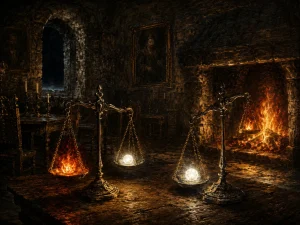
That is why the Scales of Resonance are needed here again.
They help distinguish the state.
Where is it time to warm, to see, or to change form?
Sometimes a person says he needs fire.
In reality, he usually needs warmth. He is tired, frozen and has lost support.
In such a moment, flame will only increase anxiety.
Another person asks for warmth.
Yet he needs light. He does not need pity.
It is important for him to see the real situation.
A third person seeks light.
Yet the time for fire has come. He has already understood everything.
In that case, the force of transition is needed.
Measure shows the precise role of each phenomenon.
It does not mix them into one beautiful metaphor.
Instead, it returns each place to its own meaning.
Fire, Warmth and Light are not the same thing
Light helps one see.
Warmth helps one live.
Fire helps one change.
The Sun gives light and warmth, but it does not burn like a bonfire.
Tea gives warmth, yet it is not fire.
A bonfire gives light, warmth and the transformation of matter.
Therefore the image of life becomes more precise.
Life is not equal to fire.
It can be warmth, movement, light and transformation.
At different moments, it needs different forms.
Fire, Warmth and Light together show the path.
Yet each carries its own function.
Light opens direction.
Warmth preserves connection.
Fire moves form into a new state.
Udanna Light and Awareness, new meanings are waiting.