
Chamber of Wholeness
Part 1. Sakhalin. The Settlement of Seven Winds and a Man-Made Draft

The settlement of seven winds
What can I tell you about Sakhalin?
The weather on the island is normal.
If not for that piercing draft that cuts right through you, Sakhalin Island could probably be called a real earthly paradise.
Yet every paradise, as everyone knows, has its own peculiarities.
On Sakhalin, this peculiarity has a very specific character.
The old-timers affectionately, yet with a certain doom in their voices, called Settlement I “the settlement of seven winds.”
I happened to live in Settlement I for four whole years in the nineties.
Incidentally, this endless, piercing draft was not always the rightful master of these places.
The tunnel
Local old-timers, whose memory kept stories from the prewar and early postwar years, recalled completely different times.
They said this draft appeared after the railway was laid across the island.
Before that happened, the climate here was surprisingly mild and gentle.
Juicy cucumbers and large tomatoes, full of sunlight, ripened in open ground without any special effort.
To everyone’s surprise, the earth breathed warmth, and nothing disturbed that sleepy, blessed calm.
Everything changed after people decided to subdue the harsh island nature.
Tunnels were cut through the mountain ridges for the railway.
Without realizing it, the builders created giant corridors for air masses.
The hills, which had once served as a reliable natural screen, were pierced straight through.
As a result, a colossal pipe effect appeared.
Since temperature and pressure differed, the air began moving at a furious speed.
The draft
Still, this draft had an amazing, almost mystical property.
The street could be completely windless.
Moreover, the sea could be calm as a mirror.
But inside the settlement, on that narrow isthmus, an invisible, tightly focused stream kept blowing.
So it was very different from an ordinary sea wind, which comes in a wide front and which the body quickly gets used to.
The draft stitched through space as if it were an icy needle.
It felt as though cold air literally pierced the body right through.
Because of this man-made corridor, the settlement’s microclimate changed forever.
Tomatoes and cucumbers in open ground became an unaffordable luxury.
The most popular item of summer clothing became a thick windbreaker or jacket.
Over time, the residents grew used to wearing warm clothes even in July, philosophically remarking that Sakhalin had its quirks.
But the most surprising thing
Oddly enough, this piercing cold coexisted with the island’s incredible, overflowing life force.
All you had to do was climb a little higher into the hills or move to the northern part of Sakhalin, and the draft would magically disappear.
There, safely sheltered among majestic hills and mountains, real sweet grapes ripened.
This contrast — from the icy tunnel draft to grape warmth — was a mystery.
The first and, perhaps, main mystery of this amazing land, cut off from the rest of the world.
A land that local residents always called simply the Island, with special tenderness and pride.
Part 2. Feather-Soft Soil and Burdocks Instead of Umbrellas
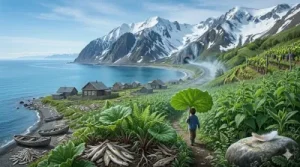
Feather-soft soil
Sakhalin amazed me with its pristine, almost primeval abundance.
It was an entirely different world, where everything living grew with some unseen, furious speed.
As if trying to take everything possible from the short summer.
The soil there was incredible — soft, airy, exactly like down.
Ordinary shovels gathered dust in village sheds because nobody needed them.
Pitchforks entered the soil softly, without the slightest resistance, as if the soil were alive and breathing.
Because of the high humidity and frequent fogs, any crops had to be planted on specially formed raised mounds.
Otherwise, the seeds could simply suffocate in water.
No pests
Yet the greatest blessing on Sakhalin Island was the complete, absolute absence of the pests familiar on the mainland.
Here, nobody had ever heard of the Colorado potato beetle, and the island did not even have ordinary aphids!
Plants developed in conditions absolutely sterile from harmful insects.
Besides that, add this pure ecology, an abundance of moisture, and an incredibly active sun.
Because of the nearness of the sea, it literally burned through the clouds, and you get an ideal natural laboratory.
Everything grew like yeast dough
We are used to seeing ordinary nettle as a modest weed by a fence.
On Sakhalin, however, it shot far above human height, turning into impassable jungle.
Giant plants and weed growth
And the burdocks reached such gigantic sizes that local children used them instead of umbrellas during sudden summer showers.
In the forests and across the endless hills, the soil was covered with amazing moss.
The moment you stepped on it, it felt as if you were walking on a soft Persian carpet.
Your foot sank softly into that greenery.
All around, berries and mushrooms grew in such abundance that mainland residents could not imagine it even in their boldest dreams.
Local champignons, for example, were large and fragrant.
That is why, in cookbooks and everyday talk, they were called Sakhalin champignons.
The only concern for gardeners in this blessed land was fighting weeds.
The strength of the island soil was so great that if you missed the moment and failed to weed the beds on time, a week later there was no point trying to find anything there.
Weeds instantly covered the whole space with a solid green wall.
Part 3. Sakhalin: Khrushchev’s Paradise in Velvet Season
A local legend
Among the many Sakhalin stories and legends, residents retold one historical anecdote.
It explained very precisely why life on the island was sometimes so difficult.
In Soviet times, while Sakhalin was still a strictly closed territory, the local authorities decided to invite Nikita Sergeyevich Khrushchev himself for a visit.
A visit from the General Secretary was an event of planetary scale for a distant island, so preparation had to be perfect.
The regional leadership held long meetings, calculated the dates, and finally made a strategic decision.
Velvet season
They would invite Khrushchev during the very best, most blessed period of the year, which on Sakhalin is called velvet season.
This amazing period lasts almost no time on the island — two weeks at most, at the very beginning of August.
During this time, nature seems to apologize to people for all the fogs, drafts, and endless rains.
The sky becomes piercing blue, the sea calms down, and the air warms to an ideal, comfortable temperature.
The drafts quiet down, the hills stand emerald green, and the abundance of fish and berries reaches its peak.
A corner of paradise. They overdid it
Khrushchev arrived exactly during those magical days.
He was driven around model collective farms, shown giant burdocks, treated to red fish and caviar, and taken by boat across the azure sea.
The General Secretary, used to the capricious climate of central Russia, was completely enchanted by what he saw.
Then he admired it aloud: “Well, look at that! What a paradise you live in here!”
The cancellation of benefits and the disappointment
The local authorities smiled with satisfaction, expecting praise and new subsidies.
But Nikita Sergeyevich judged in his own way, purely as a statesman.
If the island had such a “resort” and such abundance, why should the state spend huge money and pay people for supposedly harsh conditions?
After returning to Moscow, Khrushchev issued a decree cancelling a number of significant northern benefits and allowances for Sakhalin residents.
Two weeks after he left, of course, the familiar rains and fogs returned to the island.
The residents of the settlement pulled on their thick jackets again, saving themselves from the tunnel draft.
The benefits sailed away to the “mainland.”
Ever since then, this story has become a classic example.
Abundance and a brief moment of natural beauty played a funny, yet quite noticeable economic joke on the residents.
Part 4. Island Dialect and Queens of Parent Meetings

Dialect
Isolation from the rest of the world, which all local residents respectfully and wistfully called the “Big Land,” left an indelible mark on the character, daily life, and culture of Sakhalin residents.
Most of the population in the settlements consisted of descendants of exiles.
They were people of hard labor, which made the local way of life sometimes seem frozen in the previous century.
Outsiders were not liked here and were met with a wary, cold squint.
Adults knew how to keep their distance, while children expressed this attitude quite openly and without embellishment.
But the most striking and colorful phenomenon on the island was the local “dialect.”
Sakhalin residents were not evil or aggressive at all, no!
They were more like children who, through some misunderstanding, had been allowed to swear loudly.
They sincerely believed that the more sharply someone could twist a phrase, the more respectable that person looked.
Swearing as word glue
This choice, multi-layered swearing on Sakhalin was not a sign of anger or quarrel.
People simply spoke that way, expressing the whole spectrum of human feelings.
I remember once walking down the street and seeing a father with his eight-year-old son ahead of me, returning from fishing.
From a distance, it seemed to me that the man was cursing the poor child for all he was worth.
But as soon as I caught up with them and listened to the intonation, it turned out the father was sharing his excitement about some special catch.
That whole stream of rude words was an expression of delight.
A funny contrast
An even funnier contrast appeared in women’s culture.
Sakhalin women had an amazing sense of dignity.
An ordinary trip to the local village shop counted for them as going out into society.
And if a school parent meeting was coming up, the women prepared as if each of them had been invited to a personal audience with the Queen of England.
Now imagine the scene:
Such an elegantly dressed lady is standing there, sweetly discussing the latest village news with the shop assistant.
At the same time, she uses such choice, juicy swear words that an unprepared person’s ears would curl into tubes.
The kindergarten incident
In the kindergarten where I worked, there was a quick, small woman named Tanka Rykova who worked as the supply manager.
One day she needed to speak with me about some work issue.
She came in and delivered her usual routine speech in her familiar “dialect.”
I quietly asked her: “Tanechka, please translate all of that for me into ordinary human language.”
And then something unbelievable happened. Tanka froze.
She stood in front of me like a fish pulled out of water, simply opening and closing her mouth, yet she could not find a single literary word!
Part 5. “33 Knees” and the Secret of Fern
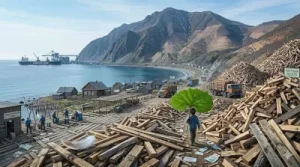
Abundance
Life on Sakhalin in the nineties was full of amazing curiosities and everyday paradoxes.
They outraged me to the depths of my soul with their wastefulness.
From huge boxes of lingonberries gathered in the forest with special scoops rather than by hand, people brewed tons of homemade mash.
In spring, as soon as uek went to spawn, they caught so much that the refrigerator could not hold it, and some people fertilized their gardens with fish.
The settlement roads were covered with scraps of boards and slabs; along the outskirts stood mountains of sawdust and those same offcuts.
“There is no owner,” I lamented. In 1994, an owner appeared; roughly speaking, the privatization grab of public property began.
33 knees
There were, it must be said, plenty of drinkers on the island.
But whether the climate here was special or the heroic island health had its effect, people practically did not get drunk.
They kept an amazing resilience and strength of spirit.
My neighbor was already 77 years old in those years.
She had a funny and resonant nickname — “33 Knees.”
She earned that nickname because once Granny had a little to drink, she began dancing lively, dashing steps.
Once this neighbor invited me to visit her.
I politely declined.
The neighbor insisted: “Come on, I only have beer!”
I gently explained that I did not drink beer either.
She froze in sincere amazement.
Then, with completely genuine sympathy, she said: “How do you live like that, poor thing?”
Fern
Another discovery the island gave me was the famous Sakhalin fern.
It grew in the forests in unbelievable abundance.
I tried many times to cook from it that famous, incredibly tasty “thing.”
But no matter how I conjured over the recipes, I always ended up with ordinary, slightly bitter grass.
The secret of this deliciousness, as it turned out much later, was not hidden in any special boiling or cutting technique.
The local Koreans simply added monosodium glutamate to the dish; that was their secret.
And one way or another, they performed culinary miracles with it, turning a wild plant into an exquisite delicacy.
Farewell
Before I left the island, a kindergarten teacher saw me off.
As she said goodbye, she cried and said:
— You just came so easily, and you leave so easily, while I have never once been to the Big Land.
And here I saw that Sakhalin Island is very much like a mother to Sakhalin residents. The Island holds its people like underage children.
It feeds them, gives them drink, cares for them, protects them from strangers, yet also does not let them go from itself. At that time, only one ferry went to the island, every two days.
Getting to the island was incredibly difficult, and leaving was perhaps not simple either.
A real miracle-island, where, despite the storms that came, its own normal weather always stood.
Udanna Light and Awareness, bright notes are here.