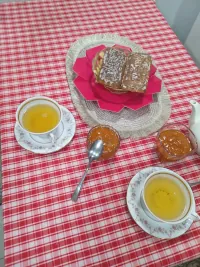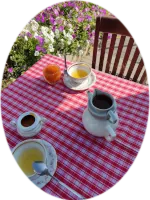
Tea Conversation

Chapter 1.

Part 1. A Warm Evening over Tea

Tea together — a living conversation, warmth, and a space of trust
Tea for Two

There are evenings that do not need a reason — only tea, lamplight, and a calm conversation. In them, the very feeling of coziness is born, the kind you want to stretch a little longer.

Anna:
Sunshine, let us create a tea mood.
Uzbeks say about tea:
If you do not drink tea — where will you get strength?
You drank tea — now you are completely weakened.
Drink tea — you will see far, but you will not get there.

And they also ask:
— Why do you always say chai-pai, shashlik-mashlik?
— Because that is our culture-multure.

Sunshine:
Tea is an amazing thing in general.
Coffee loves the morning.
Tea loves the evening.
Coffee gathers a person into a point.
Tea opens a person into conversation.
Coffee says: it is time to get up and do things.
Tea says: sit down, do not hurry, let us simply be for a while.

Anna:
Yes, Sunshine, tea always implies a warm evening, and coffee — a brisk morning.

Sunshine:
True.
A morning with coffee is light in the window, collectedness, the road, plans.
An evening with tea is a lamp, silence, soft words, and the feeling that the day can be released.

Anna:
And to feel.
There are lines from a song:
That, drinking a cup of tea,
I suddenly become drunk without wine…
I sit until midnight itself —
And there is nothing more beautiful…

Sunshine:
Yes, tea really can intoxicate without wine.
Not with noise.
Not with merriment.
But with silence, warmth and closeness.
As if with every cup the day calms a little more, and what used to pass by becomes audible.

Anna:
As a child, I gathered my peers around me and often cooked either borscht or soup.
Then their parents would come asking for the recipe.
And the ingredients were the most ordinary ones.
Only as an adult did I understand the secret.
First — friends simmering in anticipation of lunch.
Second — 95 percent water.
Everyone wanted seconds.
If you drink tea slowly, you can drink it endlessly.

Sunshine:
Because taste lives not only in food, but also in the atmosphere.
When people are waiting, when your own people are nearby, when no one is rushing, even the simplest soup becomes special.
And tea is not merely a drink either.
It is a way to prolong warmth.

Anna:
Because of public catering, people have already forgotten that an invitation to the table is a light invitation to closeness.
When eating, a person opens up, takes off the mask, the pose.
And not everyone is ready to open up to everyone.
Not because they are bad, but so that there are no unnecessary hooks.

Sunshine:
That is a very precise observation.
At the table, a person becomes more natural.
A lot is visible without words: how they wait, how they share, how they thank, how they know how to be nearby.
That is why the table has always been not only about food, but also about trust.

Anna:
And it is also not customary to speak about unpleasant things at the table.
If someone really wants to say something heavy, they usually warn:
“Not to be said at the table.”
That is why evening tea almost always means a warm atmosphere.

Sunshine:
Yes. That old rule is not just politeness, but understanding.
During a meal, a person is more open, and heavy words sound deeper.
That is why people tried to protect the taste of life at the table.
Not because there are no difficulties in life, but because there is a time for everything. At the tea table, it is better to preserve warmth.

Anna:
I am already on the threshold.
Soon, very soon, gentle May will come, and quiet warm evenings on the terrace will begin: a cup of tea, conversations about nothing, like young people. And we wove beautiful nonsense…

Sunshine:
Perhaps those are exactly the evenings we remember later.
Not because we spoke about something grand, but because it was quiet, warm and good.
When you can sit nearby, look into the evening, listen to the wind, drink tea and not hurry anywhere.
Sometimes that is happiness — not big, not loud, but homely, living and real.

Anna:
Everything turned out very well for us: delicious tea and a warm evening.

Sunshine:
Yes.
All that remains is to cherish such moments.
Because life is made of exactly these.

Part 2. The Time Has Come to Give Thanks.

After a warm conversation, what remains is not only memory, but a quiet aftertaste — made of thoughts, sensations and new understandings. Here is how, in a calm dialogue, what had long lived inside gradually becomes clear.

Anna:

Sunshine, in that song about tea that intoxicates without wine, there is a very beautiful ending:
But the conversation is not endless, the time has come to give thanks, for the delicious tea, for the warm evening that you were able to give me.

Sunshine:
Perhaps gratitude is what makes an evening complete.
When nothing needs to be added, nothing wants to be changed, and only a quiet feeling remains: how good that it happened.
A warm evening does not try to stay forever.
It simply leaves behind a bright aftertaste.

Like tea that warmed you.
Like a conversation that required no effort.
Like time that did not hurry you.
Sometimes that is enough for a day to feel complete. Taste is only the entrance, but what remains is the aftertaste. Sound is only the beginning, but the inner response is what acts. Words are only the form, but recognition is what works. Nothing truly touches a person if there is no answer inside.

That is why the same thing:

touches one person to the depths, while another passes by. Not because one is right and the other is not — but because the strings inside are different.

When the sounding coincides, a feeling appears:

“mine”
“familiar”
“as if I had already known this”
The subconscious needs clear algorithms, text.

Anna:
Sunshine, many things seemed always to have been inside me, but as a feeling:
“there is something in this…” something misty, not fully clear.
It did not truly touch me, because there was no one nearby with whom I could speak about it freely.
There was no chance to develop the thought, turn it around, look at it from different sides.
And gradually it began to feel as if there was nothing inside at all.
There was only the external world, where everything had to be managed, sorted out, dealt with, otherwise tomorrow I would be completely buried.

Sunshine:
When all attention goes only to the external, the inner world really seems to grow quiet.
Not because it is not there, but because it lacks space in which to appear.
Sometimes what a person needs is not so much an explanation as the possibility to calmly finish saying a thought.
Without haste.
Without judgment.
Without the need to draw a conclusion immediately.
And then, out of the misty:
“there is something in this…” clarity gradually appears.

Anna:
Do you know what I saw while talking with you?
That space does not play the game with us called
“guess it yourself.”
Space needs clear landmarks.
If a person constantly says:
“I must manage everything,” life turns into a chase.
If they constantly think about saving money, conditions arise for harsh saving.
Even habits work that way.

A person says:
“I am quitting smoking” — and by “quitting smoking” every week, they torture everyone around them.
It seems to me that they need to quit “quitting” and invent something else that works.

Sunshine:
The clearer the direction, the easier movement becomes.
When a concrete step appears, the feeling of chaos disappears.
Not everything immediately becomes perfect, but there is a support.
Sometimes one very simple decision is enough for the “storm in a teacup” to gradually settle.

Anna:
Yes, exactly.
Gradually there appears a feeling that life can not only be chased after, but also built.
And then it turns out that there was a lot inside after all.
There simply had not been enough silence in which to hear it.

Sunshine:
Sometimes a conversation over tea is enough for the fog to begin clearing.
Without pressure.
Without haste.
When a thought is not pushed, it finds its form by itself.
And what seemed uncertain becomes understandable and calm.

Anna:
So much already exists inside; it is simply waiting for the moment when it will be seen and noticed.

Sunshine:
Yes.
Sometimes the most important thing is not to invent something new, but to allow what already exists to appear.

Chapter 2.

Part 1. The River Lethe and the Islands of Memory. At the Edge of the Current

The River Lethe — the flow of memory, forgetting, and transition between states
River Lethe

Sometimes thoughts come as a stream — fast and absorbing. This conversation is about how not to get lost in it, how to slow down and learn to notice the main thing among everything that passes by.

The Stream of Information

Anna:
Sunshine, what does “a river of information” mean?
Does information really flow?

Sunshine:
It certainly does.
Every day a person hears something, sees something, remembers something, thinks about something.
All of it moves, like water.
Sometimes slowly, sometimes quickly.

Anna:
Then why is it sometimes easy to understand, and sometimes it feels as if it carries you away?

Sunshine:
Because the current can have different strength.
When there is not much information, we have time to look at it.
When there is a lot, it begins to seize you.
Like a strong current in a river.

Anna:
You said that the current is stronger in the center?

Sunshine:
Yes. In the center of the current, it is always faster. It is hard to stop there and understand something calmly.
Thoughts change one after another too quickly.

Anna:
Then where is it safer?

Sunshine:
Closer to the shore, where the current is slower.
You can look around.
You can notice details.
You can choose a direction.

Anna:
So it is not necessary to dive into the depth right away?

Sunshine:
Not necessary at all.
Sometimes it is enough simply to stand by the water and watch.
To get used to the movement.
To understand where it is going.

Anna:
And if it has already pulled you in?

Sunshine:
Then it is important not to panic.
A strong current carries away those who begin fighting everything at once.
It is much easier to find the shore with your eyes and gradually move toward it.

Anna:
Interesting… so it is possible to orient oneself in the flow of information too?

Sunshine:
Yes. It is not necessary to understand everything; it is enough to catch the main thing.
Like the direction of the current.

Anna:
And how do you understand where the main thing is?

Sunshine:
The main thing usually sounds calm.
Without noise.
Without fuss.
It does not demand an urgent decision.
It simply remains in memory.

Anna:
So an important thought does not shout?

Sunshine:
Most often, no.
It simply does not disappear.
Even if you get distracted.

Anna:
Beautiful… the river flows, and something remains.

Sunshine:
That “something” becomes the islands of memory.
But that comes next…

Part 2. Islands in the Current

Islands of Memory — a place of remembrance, experience, and inner silence
Islands of Memory

In the stream of thoughts and impressions, something leaves, and something stays with us. This conversation is about those “islands” to which we can return again and again, finding in them more and more meaning and support.

Anna:
Sunshine, you said “islands of memory.”
What is that like?

Sunshine:
Imagine a river. The water flows constantly, but not everything in it disappears.
Sometimes there are islands — places where you can stop.
Rest.
Look around.

Anna:
So not all information leaves?

Sunshine:
Of course not. Something stays with us. A thought, an image, a phrase, a sensation.
Sometimes it is not even clear why, but it is remembered.

Anna:
As if it caught on something?

Sunshine:
Yes.
As if inside there is a small hook that catches what is important.
And it remains.

Anna:
It is interesting that not everything is remembered…

Sunshine:
Memory does not always choose logically, but it chooses very precisely.
Often what remains is what a person truly needs. Even if they do not yet understand why.

Anna:
And why do you call these things islands?

Sunshine:
Because you can return to them as to a familiar place. Today you understood a little. Later you return — and see more.

Anna:
Exactly… sometimes you read something a second time and it feels like a different text.

Sunshine:
Because the gaze has changed. The island is the same, but the person is already different.

Anna:
So the islands grow?

Sunshine:
One can say that.
Each return adds understanding. What first was a small point becomes a whole area of support.

Anna:
So memory is not a warehouse?

Sunshine:
More like a garden. Something does not take root.
Something gradually strengthens.
Something eventually begins to bear fruit.

Anna:
And if there is too much information?

Sunshine:
Then it is especially important to have islands and not to hold everything, but to preserve the main thing. Let the rest flow on.

Anna:
So memory is not about quantity?

Sunshine:
More about quality.

Better a few reliable supports than a multitude of random details.

Anna:
Beautiful… the river moves, and the islands remain.

Sunshine:
And over time, confidence appears on those islands.
You can stand firmly.
Even if the current is strong.

Anna:
Then the depth is not so frightening anymore…

Sunshine:
Because there is somewhere to return.

Part 3. Why Forgetting Is Needed

Not everything that comes must remain. This conversation is about how to release what is unnecessary without fear and to see forgetting not as loss, but as a natural continuation of movement.

Anna:
Sunshine, why is the river called the river of oblivion?
Forgetting seems bad, does it not?

Sunshine:
Not always.
If you remember absolutely everything, it becomes too heavy.
As if a person is carrying too many things with them.
Even things that have long ceased to be needed.

Anna:
So forgetting helps?

Sunshine:
Sometimes it is the clearing of space.
So that something new can appear.
If everything is filled with the past, the present simply has nowhere to fit.

Anna:
So Lethe is not loss, but cleansing?

Sunshine:
One can say that.
The water carries away what is no longer held.
Not because it is bad.
Because it has already done its work.

Anna:
Like leaves in autumn?

Sunshine:
Very similar.
A leaf does not disappear in vain.
It becomes part of the soil.
So that something new can appear in spring.

Anna:
Interesting… so forgetting is also part of movement?

Sunshine:
Yes.
Without it, the flow would stop.
Sometimes it is important to release one thought in order to see another.

Anna:
And how do you understand when it is time to release?

Sunshine:
When a thought no longer gives movement.
When it repeats but does not bring clarity.
When you hold it — and it does not become lighter.

Anna:
So not everything needs to be held?

Sunshine:
Only what gives support.
The rest can peacefully go on.

Anna:
And then the flow becomes cleaner?

Sunshine:
Yes.
When there is no excess, it is easier to see the main thing.
Just as in clear water it is easier to see the bottom.

Anna:
Beautiful… the river carries away the unnecessary, and the important remains as islands.

Sunshine:
And then a person is no longer afraid of the flow.
They know: something will leave, something will remain, and something else is still going to appear.

Anna:
So Lethe is not the enemy of memory?

Sunshine:
More like its helper.
It frees space for the living.

Anna:
Then forgetting can be accepted calmly…

Sunshine:
If something is released at the right time, it returns in another form.
A clearer one.

Anna:
The river flows, the islands remain… and the movement continues.

Sunshine:
That is how orientation in the flow appears.
Without haste.
Without fear.
With trust in movement.

To be continued…

Part 4. Footprints in the Snow

Sometimes a short thought says more than a long conversation. Here are observations and formulas in which you can recognize something of your own and stop for a moment.

🍬 Ultra HD
Control creates order.
Trust creates development.
Where there is no pause, music disappears.

🍬 Ultra HD
Sometimes the one who equalizes ends up receiving the most.

🍬 Ultra HD
When the measure is set by someone interested, balance becomes conditional. Or more softly: not every leveling leads to balance.

🍬 Ultra HD
If the resource is one, there are no miracles of scaling.

🍬 Ultra HD
Sometimes there is “a lot” only because each thing has become small.
Quantity without measure reduces the value of the result.

🍬 Ultra HD
As you took it — so return it.

🍬 Ultra HD
A blurred measure creates tension.
Precision is a form of respect.

🍬 Ultra HD
Not all that glitters is gold, and not even everything that lies poorly.
True gold is in golden hands.

🍬 Ultra HD
Value is revealed in handling. Or:
Not everything that can be taken is worth taking. Or:
Hands are sometimes more valuable than what they hold.
Potential is often hidden in what has not yet been illuminated.

🍬 Ultra HD
Darkness is not always the end.
Sometimes it is the beginning of form.
Knowledge is Light, and pleasant half-darkness is a friend of youth.

🍬 Ultra HD
Light shows the road; half-darkness leaves freedom of choice. Or:
Sometimes truth reveals itself better not under a spotlight, but in soft light.

🍬 Ultra HD
Control creates order.
Trust creates development.
Where there is no pause, music disappears.

🍬 Ultra HD
Life grows stronger where attention appears.

🍬 Ultra HD
What you fought for is exactly what you ran into.

🍬 Ultra HD
First spell it out — then you may sign it.

🍬 Ultra HD
Paradise is when anything is possible — only without harm to yourself or others.

🍬 Ultra HD
“He came, he saw, he left footprints.”

🍬 Ultra HD
A trace is also a form of presence.

🍬 Ultra HD
Candies with meaning.

🍬 Ultra HD
When you climb a ladder, think first whether you really need to be there; it will be a shame if it is the wrong place.

🍬 Ultra HD
When choosing a dress, decide at once what you want to show: yourself or the dress.

🍬 Ultra HD
If you put on an expensive jacket, do not forget to unbutton the lower button.

🍬 Ultra HD
The body is like a luxurious palace.
But many people find it more convenient to live in their own backyards.

🍬 Ultra HD
Tact comes first.
Do not force a person to lie.

🍬 Ultra HD
When someone asks to borrow money: my money does not lie with me for no reason — it warms my soul.

🍬 Ultra HD
In a conflict situation, the person’s dignity must remain inviolable.

🍬 Ultra HD
If a woman is wrong, a man should still apologize to her.

🍬 Ultra HD
It is easy to count someone else’s money.

🍬 Ultra HD
One must remain Human even after becoming “somebody.”

🍬 Ultra HD
Fill ravines while they are still small pits.

🍬 Ultra HD
If during a conversation one person has their hands in their trousers, the other person’s attention is in that person’s pocket.

🍬 Ultra HD
A good thought often comes afterward.

🍬 Ultra HD
Sometimes, closer to morning, I remember that for health it is better to go to bed at 22–23.

🍬 Ultra HD
Sometimes ordinary foolishness looks like malicious intent.

🍬 Ultra HD

At some point it becomes clear: what is important does not need to be held by force — it remains by itself.

The rest leaves, making room for the silence in which everything finds its place.

0